
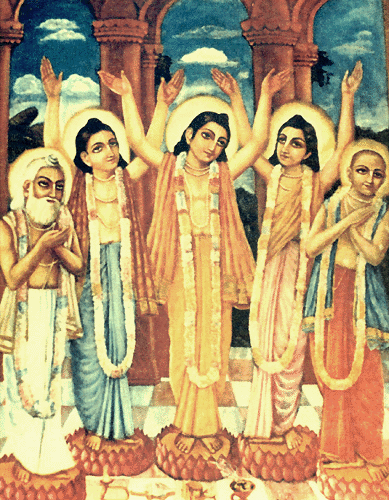
Our Lord Śrī Kṛṣṇa Caitanya moves in mysterious ways, not easily understandable. This is described by Śrīla Rūpa Goswami as moving like a snake, in a crooked manner, often with hidden purpose. To the trained eye of devotion it is obvious. Although He exists solely for Himself and His own pleasure, His actions are ultimately for our benefit.
Mercy
There is a prominent theme of encouragement for our devotional endeavors throughout Kṛṣṇa’s Bhagavad-gītā and His innermost desires are most evident during His divine appearance as Śrī Caitanya Mahāprabhu. Kṛṣṇadāsa Kavirāja Goswami provides us in his extensive Caitanya-caritāmṛta with the most complete ontological explanation of the entirety of Mahāprabhu’s pastimes and His saṅkīrtana movement for the distribution of His mercy to us. The Caitanya-bhāgavata of Vṛndāvana Dāsa Ṭhākura parallels the Caitanya-caritāmṛta with additional details.
Such great souls who have provided us with the many narrations of the Lord’s pastimes and instructions are themselves inhabitants of the same transcendental plane of reality which they reveal to us. Our spiritual heritage, our real wealth, has come to us through them, our ācāryas. These intimate associates of the Lord have descended to this world by the Lord’s desire for our benefit. The depth, clarity and truths revealed in their writings can only be conveyed by those who have directly lived that life. They infuse their divine revelations with the potency necessary to penetrate the many material (māyic) coverings of our pure spiritual essence. They awaken it, nourish it and guide us on the true path to the lotus feet of the Lord and His blissful service. This is the essence of bhakti, the yoga of devotion, and Śrī Caitanya Mahāprabhu is the fountainhead of His glorious saṅkīrtana mission.
Approaching the Divine
Vaiṣṇava tradition dictates that divine personalities are always approached with humility, submission and respectful words of glorification — prayers. Additionally, Bhagavad-gītā 4.34 reveals the formula for learning from such higher Vaiṣṇavas — praṇipāta, paripraśna and sevā.
Any appearance of the Lord within this material world is accompanied by the appearance of many of His innumerable associates who assist in His pastimes directly and indirectly. Notable amongst our ācāryas is the Pañca-tattva:
pañca-tattvātmakaṁ kṛṣṇaṁ
bhakta-rūpa-svarūpakam
bhaktāvatāraṁ bhaktākhyaṁ
namāmi bhakta-śaktikam
I offer my obeisances unto the Supreme Lord, Kṛṣṇa, who is non-different from His features as a devotee, devotional incarnation, devotional manifestation, pure devotee and devotional energy. (Cc. Ādi-līlā 1.14)
This verse of Kṛṣṇa Dāsa Kavirāja Goswami refers to five truths (tattvas), collectively known as the Pañca-tattva. Śrīla Bhaktisiddhānta Saraswati Ṭhākur comments: “The Supremely Potent is revealed in five different manifestations according to His desire to experience five different pastimes. Ontologically there is no difference between them: they are one truth, tattva, expressed in five varieties. Thus Śrī Gaurāṅga Mahāprabhu, Śrī Nityānanda, Śrī Advaita, Śrī Gadādhara and Śrī Śrīvāsa and all the other devotee associates of Śrī Caitanya Mahāprabhu are ontologically non-different from one another.”
Divine Sound
A Gauḍīya Vaiṣṇava’s chanting of the Holy Names of the Lord takes form in the Mahā Mantra:
Hare Kṛṣṇa Hare Kṛṣṇa Kṛṣṇa Kṛṣṇa Hare Hare,
Hare Rāma Hare Rāma Rāma Rāma Hare Hare
This is the only means for achieving perfection in Kali-yuga (Bṛhad-nāradīya Purāṇa 3.8.26). It is further recommended that the chanting of the Mahā Mantra be preceded by the chanting of the Pañca-tattva Mantra — Jaya Śrī Kṛṣṇa Caitanya, Prabhu Nityānanda, Jaya Advaita, Gadādhara, Śrīvāsādi, Gaura Bhakta Vṛnda. This invokes the blessings of these five forms comprising the entirety of Śrī Caitanya Mahāprabhu and His mercy. Śrī Caitanya, being the most merciful manifestation of the Lord, does not take offense at any devotee’s inadvertent mistakes in their sincere execution of devotional service.
Loving Pastimes
Śrī Caitanya and His many exalted associates constantly exhibited great affection amongst one another and shared many relishable pastimes together, most of which involved rousing kīrtana sessions and the joyous consumption of large amounts of carefully prepared prasādam. By the mercy of our Divine Master Śrīla A. C. Bhaktivedanta Swami Prabhupāda, these wonderful exchanges continue to this day all over the world with uncountable numbers of devotees daily chanting Hare Kṛṣṇa with great enthusiasm and sharing prasādam amongst themselves — two of the most important methods of increasing devotion.
Most relishable of our many devotee festivals in the āśram throughout the years is always that of joining together with so many loving devotee friends in joyous observance of our devotion, with intense kīrtans of the Holy Names of the Lord and the offerings and acceptance of Bhāgavat prasādam by all.
One cannot but realize how identical these enlivening festivals are to the pastimes of Lord Caitanya and His loving devotee associates, as described in great detail in the Caitanya-caritāmṛta. During our gatherings on holy days, the many bhajans chanted together and the intense kīrtana sessions vibrate the Holy Names in our consciousness for hours on end, infusing our entire beings with an exalted spiritual essence, intoxicating the devotees and overwhelming them all with great joy.
Prasādam Pastimes
And always, this is topped off with incredible feasts of unlimited preparations, lovingly prepared with great devotion. Many times our devotees have prepared various dishes according to the instructions given in the Caitanya-caritāmṛta, duplicating these very same offerings as during the time of Mahāprabhu. Recipes from the Jagannātha Temple in Purī are also prepared precisely according to their instructions. Guru Mahārāja very much appreciated this, and the devotees have always been happy to do this — thus entering more directly into the spirit of Caitanya-līlā.
This is truly the heart of devotional life — becoming so absorbed in the Holy Names, devotee association and the sharing of prasādam together, thereby significantly uplifting our spiritual advancement.
Serving, Sharing and Saṅkīrtana
In the sharing of our service with godbrothers and godsisters over many years, we gain so many experiences and grow together from the many struggles endured — both the good and bad occasions — strengthening and tempering our devotion. The trust grown from this helps solidify deep faith in our spiritual process. All of these experiences make us stronger and help us navigate this toxic world, while continuously increasing our devotion.
During our early days in the Brahmacārī āśrama, devotees always looked forward to the arrival of the Saṅkīrtana Newsletter reporting the distribution of Śrīla Prabhupāda’s books all over the world by devotees in so many different countries. Everyone looked forward to reading about their endless confrontations with the many obstacles that always arose to oppose the saṅkīrtana movement.
Prabhupāda’s introduction of the chanting of the prayers to Lord Narasinghadeva helped lessen the anxieties of such opposition. Devotees had to deal with administrators, police, demons and physical violence. The endless enthusiasm of the saṅkīrtana devotees’ struggles to spread Kṛṣṇa consciousness is glorious to be a part of.
The Newsletter highlighted the opposition endured by the many book distributors worldwide, enthralling and enlivening devotees everywhere as they read these exciting accounts — all the while cheering for the devotees’ successes and valiant clashes with the many demonic forces.
Śrīla Prabhupāda, hearing of some of the more intense clashes with angry demons, police abuse and strong opposition, exclaimed, “Now, we are really preaching.” For strong preaching polarizes the people — they love you or they hate you. Weak watered-down preaching, is just ignored. No one cares. But when your words penetrate into the hearts of the conditioned souls and awaken their dormant spiritual nature or conversely their demoniac opposing desires. Then strong reactions occur, for your preaching is truly successful. Opposing demons simply cannot tolerate the glorification of Godliness.
More Prasādam Pastimes
There was also a column in the Brajabasi Spiritual Journal titled, “Confessions of a Prasādam Addict,” detailing a favorite pastime of many devotees — stealing the Mahā Prasādam. Guru Mahārāja relates several particularly humorous and enlivening stories involving himself.
When he was preaching in South Africa under Brahmānanda Swami, he was singlehandedly supporting one of the major temples there, Durban or Johannesburg, and after returning from an extended collection trip where he did not meet any English speaking people for months, with no temple prasādam, he swiped and consumed the entire mahā plate from the Deity offering. During prasādam later, Brahmānanda Swami was very upset to learn that “someone” had stolen the Mahā and asked in a loud and obviously angry voice, “Who took the Mahā Prasādam?” Guru Mahārāja raised his hand and said simply, “I took it, Mahārāja.” Brahmānanda Swami was unable to say anything as Guru Mahārāja had sacrificed so much to travel and collect for the temple. So that was the end of it.
Once during prasādam, Śrīla Prabhupāda handed Brahmānanda Swami a sweetball from his plate after taking a bite out of it, promoting the Mahā Prasādam to Mahā Mahā Prasādam. Another devotee to his right quickly grabbed the sweetball off his plate and immediately swallowed it himself. Brahmānanda complained to Prabhupāda, who simply replied, “Ahh, Vaikuṇṭha qualification,” showing no sympathy for Brahmānanda.
Another time in Philadelphia, Mahārāja (then a brahmacārī) had duplicated a key to the Mahā Prasādam lock box, locked to prevent devotees from stealing the mahā, as was common. Some just unscrewed the hinges. Mahārāja told me that one night he was taking some prasādam out of the box in the dark, when the lights flicked on and the temple president caught him red-handed. Again, somehow, Mahārāja didn’t get into much trouble. Such are a few of the many prasādam pastimes of devotees.
Śrī Nityānanda
Śrī Nityānanda is the fountainhead of numerous forms of the Lord and the source of Guru-Tattva, the guiding principle which awakens our dormant relationship with Kṛṣṇa and continues to nourish our bhakti path of devotion with transcendental knowledge and personal guidance. Locana dāsa Ṭhākura writes in his songs that “Śrīla Nityānanda Prabhu is more merciful than even Śrī Caitanya.” And Śrīla Bhakti Pramoda Purī Mahārāja has stated that, “As soon as anyone chants the names of Lord Caitanya and Nityānanda, he is awarded the ecstasies of love of God.”
Śrī Advaita
Advaitācārya was a great scholar and boldly championed Vaiṣṇavism during a time of great decline and minimal interest. He preached its doctrines fearlessly along with offerings of tulasī and Ganges water to his Śālagrām and prayed for the Lord to advent and counter the predominating wave of irreligiousity at that time.
Advaitācārya and the associates of Śrī Caitanya Mahāprabhu engaged in many wonderful playful pastimes with the Lord. During one humorous exchange, Advaita accused Lord Nityānanda of being a “bhraṣṭa avadhūta,” a reject paramahaṁsa, accepting the renounced life simply to fill his belly and trouble the brāhmaṇas. Our ācāryas write that his jokingly stated apparent insult actually was an acceptance by Advaitācārya of Lord Nityānanda as a paramahaṁsa.
More Loving Pastimes
Sārvabhauma Bhaṭṭācārya, a former stoic dry logician was converted by Śrī Caitanya through His astounding explanations of the Ātmārāma verse. Sārvabhauma Bhaṭṭācārya’s bathing pastimes — splashing happily in a kuṇḍa with Rāmānanda Rāya, Mahāprabhu, and others in Jagannātha Purī like little children — immediately came to my mind once in Hawaii during an ocean dip. A sannyāsī godbrother of mine was enjoying the waves at the Black Sand Beach in Waipio Valley. He was grinning from ear to ear like a small kid, reminding me instantly of the playful water pastimes Sārvabhauma Bhaṭṭācārya, Rāmānanda Rāya, Mahāprabhu, and other devotees once shared in Purī. This is described in Cc. Madhya 14.82, “Sārvabhauma Bhaṭṭācārya engaged in water sports with Śrī Rāmānanda Rāya and they both lost their gravity and became like children.”
Many such light-hearted loving pastimes often took place amongst Śrī Caitanya Mahāprabhu and His intimate associates. They revealed the deep affection and respect amongst all these elevated personalities, for they are indeed of the highest quality. Hearing of these wonderful pastimes nourishes our devotional creeper and helps to solidify our progress in devotional service.
Śrī Gadādhara Paṇḍita
Gadādhara Paṇḍita is described as the pure energy of the Lord and “a perfect brāhmaṇa spiritual master.” He is a manifestation of Śrīmatī Rādhārāṇī and first amongst Mahāprabhu’s intimate associates. Pure devotees who wish to worship the sweet features of Śrī Śrī Rādhā-Govinda take shelter of Gaura-Gadādhara’s uniquely identical rasa and thereby become even more intimate devotees of Rādhā-Govinda. Śrīla Bhakti Pramoda Purī Goswami Mahārāja has written that, without worshipping Gaura-Gadādhara, we cannot worship Śrī Śrī Rādhā-Govinda.
Gadādhara maintained an intimate friendship with Lord Caitanya from childhood throughout his life, relishing many wonderful pastimes together in Navadvīpa. After Mahāprabhu took sannyāsa, Gadādhara accompanied Him to Jagannātha Purī, where he engaged in continuous devotional service, reciting the Śrīmad-Bhāgavatam daily at the Ṭoṭā Gopīnātha temple with deep emotion for the pleasure of Śrī Gaurāṅga and His closest associates, including Svarūpa Dāmodara and Rāmānanda Rāya.
Śrīla Śrīdhara Mahārāja glorified the unique position of Gadādhara Paṇḍita by composing the poetic nīlāmbhodi-taṭe sadā sva-viraha-kṣepānvitaṁ bāndhavaṁ verse. It illustrates Gadādhara Paṇḍita’s deep relationship with Mahāprabhu and the solace Gadādhara provides for Him in his daily recitations of the Śrīmad Bhāgavatam to allay Mahāprabhu’s deep feelings of internal separation from Kṛṣṇa in the mood of Śrīmatī Rādhārāṇī.
Under Mahāprabhu’s instruction, Gadādhara took kṣetra-sannyāsa with a vow to stay in Purī and maintain worship of the Ṭoṭā Gopīnātha Deity. He continuously maintained a profound attachment to Śrī Caitanya Mahāprabhu. After the Lord’s disappearance, Gadādhara Paṇḍita, unable to bear the pain of separation, departed from this world eleven months later.
Śrī Śrīvāsa
Śrīvāsa Paṇḍita is the śuddha-bhakta (the pure devotee). He is the same Nārada Muni from Kṛṣṇa’s eternal pastimes, the Nārada who is the original preacher of devotional service, the divine sage who wanders the three worlds chanting the Holy Names and awakening devotion in the hearts of everyone he meets.
During Mahāprabhu’s pastimes in Navadvīpa, Śrīvāsa’s home — Śrīvāsa Aṅgana — became the sacred sanctuary of continuous nocturnal kīrtans — the very origin of the eternal saṅkīrtana movement of Śrī Caitanya in this world. Within those walls, Mahāprabhu and His most confidential associates gathered nightly in their joyous chanting of the Holy Names. These spiritually charged sessions, overflowing with divine love and ecstatic manifestations, were hidden from the general public. Only a few intimate devotees were allowed to participate, because outsiders disturbed the sanctity of the Lord’s pure chanting.
So complete was the surrender of Śrīvāsa and his family that when his son passed away during one of these all-night kīrtans, Śrīvāsa, unwilling to interrupt the Lord’s transcendental pleasure, hid this from Śrī Caitanya until much later when the kīrtan was finished. This exemplary devotional character of Śrīvāsa Paṇḍita shows us that pure devotion is necessary for a complete manifestation of Śrī Caitanya Mahāprabhu’s mission. Without a pure devotee, the saṅkīrtana movement has no living expression, which means that every saṅkīrtana party must include at least one pure Vaiṣṇava to assure its potency and beneficial effect.
Divine Dispensation
Our Vaiṣṇava lineage descends and spreads through our predecessor and present ācāryas, who have descended from their eternal spiritual līlā with the Lord, to assist in His glorious saṅkīrtana movement — paraṁ vijayate śrī kṛṣṇa saṅkīrtanam.
The Premadhvani prayers we recite daily in conclusion of ārotikas and kīrtanas recognize these highly exalted divine personalities for their essential contributions to our spiritual lives. Following in the footsteps of these great souls by reciting their numerous prayers to the Lord, found throughout the scriptures, helps us attain a humble, submissive state of mind. Familiarity with their superexcellent pastimes and qualities, along with their glorification, enhances our likelihood of achieving their blessings.
These great souls have mercifully appeared here in the material realm to engage us in eternal devotional service. By Their mercy and upon each of our own personal tireless endeavors in bhakti Yoga, we are promised by Lord Kṛṣṇa to reach His eternal perfect abode and join Him there in Goloka Vṛndāvan — manmanā bhava mad-bhakto (Bg. 18.65). This provides an inspiringly strong motivation to all bhaktas and potential bhaktas to wholeheartedly embrace a continuous life of devotion.
The realm of Goloka is wonderful in every way to the fullest extent — it is spiritual perfection, exhibiting the greatest qualities of spiritual reality. It is eternal, sat, full of knowledge, cit, and endless pleasure, ānanda. We compare this to the material realm we currently occupy, which is temporary, with a lower than ever diminishing life expectancy, and in comparison to the totality of knowledge available, keeps us in relative ignorance.
Realistically, we suffer from many miseries and difficulties in spite of modern technological advancement. This comparison leaves us with only one reasonable choice — an eternal life full of wisdom and happiness. It is as simple as choosing to live the life of a devotee and remain steadfast in our devotion — for when we make a genuine attempt to follow the process, Kṛṣṇa will help us — yoga-kṣemaṁ vahāmy aham (Bg. 9.22).
May the chanting of the Holy Names of the most merciful Pañca-tattva and the Mahā Mantra purify our hearts and carry us swiftly to that eternal land of perfection. All glories to saṅkīrtana.