
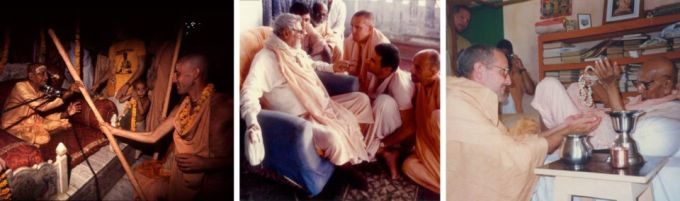
A transcendental confluence of guidance & shelter under our affectionate guardians— Śrīla A. C. Bhaktivedānta Swāmī Prabhupāda, Śrīla B. R. Śrīdhara Mahārāja, and Śrīla B. P. Purī Mahārāja.
(This article was originally published in the book Sampradāya Prakāśa)
The grand preaching movement outside India spread from the determination of (Our great‑grandfather guru) Śrīla Bhaktivinoda Ṭhākura’s prayers to the Lord for help in spreading this message and saving the fallen population from their degraded, wasted lives, as he perceived the climate at that time. This was answered with the birth of his divinely inspired son, Śrīla Bhaktisiddhānta Sarasvatī Ṭhākura — proclaimed a “Rāy of Viṣṇu,” who founded the Gauḍīya Maṭha Mission and trained and sent some of his disciples outside India to preach.
The world knows of Bhaktivedānta Svāmī Prabhupāda’s success, but there were other less successful disciples of Sarasvatī Ṭhākura sent to England and Germany prior to Śrīla Prabhupāda’s successful preaching in North America. Amongst his stalwart god-brothers, it was recognized that Kṛṣṇa specifically chose to empower Śrīla Prabhupāda to spread His message far and wide.
Mission history
Śrīla A. C. Bhaktivedānta Svāmī Prabhupāda miraculously spread the bhakti‑yoga culture, more commonly known as the Hare Kṛṣṇa Movement, all over the world. In the days after the disappearance of Śrīla Prabhupāda in 1977, his society suffered a vacuum of uncertainty without his leadership.
The GBC (Governing Body Commission) of ISKCON regularly sent a devotee (Dhīra Kṛṣṇa Mahārāja) to Śrīdhara Mahārāja to ask many questions, looking for guidance as they newly accepted their position as successive gurus in ISKCON.
Many regular devotees also sought śikṣā (spiritual advice) from Śrīla Śrīdhara Mahārāja — answers to important questions of every nature relating to their spiritual lives. Although initiated by the GBC as instructed by Śrīla Prabhupāda, this śikṣā was later stopped. All of this history is carefully documented in the book Our Affectionate Guardians.
In late 1986, the two of us (Nārasiṅgha Mahārāja and the author) formally left ISKCON and joined the Gauḍīya Vaiṣṇava Society of three sannyāsī godbrothers. For Gaura Pūrṇimā 1987, our five sannyāsīs and members journeyed together to meet with Śrīla Śrīdhara Mahārāja in Navadvīpa, formally recognizing him as our principal śikṣā‑guru.
We were all captivated by Śrīla Śrīdhara Mahārāja's narration of the divine description of the process of journeying to the highest limits of our devotion, entering into our final destination in life — the spiritual realm of Goloka Vṛndāvana. This greatly impressed and inspired all of us to seek further guidance from Śrīla Śrīdhara Mahārāja. His scriptural teachings became a major contributing factor to the activities and goals in our mission.
It was named the Gauḍīya Vaiṣṇava Society — its purpose aligned with those of Śrīla Prabhupāda and tempered by the realizations of Śrīla Śrīdhara Mahārāja. We were no longer members of Prabhupāda’s formal society — which we had all served faithfully for many years. Now we were still serving our guru under a different banner with the same ideals.
Our frequent visits to India usually included visiting Vṛndāvana, the holy center of Kṛṣṇa’s earthly activities, finally purchasing our own building there and opening a branch of our Society. Our International Gauḍīya Vaiṣṇava Society mission formally started in 1990 with the purchase of Rūpānuga Bhajana Āśrama and the initiation of disciples by Narasiṅgha Mahārāja. During Śrīla Prabhupāda’s talk after giving Narasiṅgha Mahārāja sannyāsa along with other devotees, he instructed them to become gurus and spread Śrī Caitanya’s message.
Narasiṅgha Mahārāja was always fixed on executing his service as Śrīla Prabhupāda instructed. All the members of our mission continuously heard from him the most important standards and instructions Prabhupāda taught with his every breath.
We traveled continuously, always visiting the places of the Lords’ pastimes, and establishing āśramas in places deemed auspicious for preaching activities, such as Tiruvananthapuram (Trivandrum), Kerala and Mulki, Karnataka in South India; Vṛndāvana in North India; Vermont in the USA; Italy. We ultimately closed the Rūpānuga Bhajana Vṛndāvana Āśrama and consolidated our members in Govindajī Gardens in Srirangapatna, near Mysore on the holy River Kaveri, so we could all work together fulfilling Mahāprabhu’s instructions.
Our Gurus
Śrīla Prabhupāda established an international structure, an institutionalization of the process of bhakti‑yoga and spread it all over the world — an unprecedented and incredible accomplishment. Others had come from India to the West but their impact was minimal in comparison to the arrival of Śrīla Prabhupāda and his overwhelming success. This author owes an eternal debt of service in submission to Śrīla A. C. Bhaktivedanta Swāmī Prabhupāda (my initiating spiritual master and principal guru) — a debt which we embrace wholeheartedly as our life and soul.
Śrīla Śrīdhara Mahārāja established his own mission, the Śrī Caitanya Sārasvata Maṭha, after the passing of Śrīla Bhaktisiddhānta Sarasvatī Ṭhākura. At the behest of his godbrothers (both members and non‑members of the Gauḍīya Maṭha) he provided much‑needed guidance and spiritual leadership to his guru’s Gauḍīya Maṭha mission during critical times. At this time he lived next to Śrīla Prabhupāda at Sita‑kaanta Banerjee Lane in Calcutta.
Śrīla Śrīdhara Mahārāja later provided much‑needed shelter and guidance to Śrīla Prabhupāda’s disciples in times of necessity. In this regard, he stated in essence,
“You all have come here and forcibly you are dragging down from above, through me, so many answers to many religious and philosophical questions of endless variety.”
His most valuable and profound contribution was his clarification of and deep realizations of the Gauḍīya siddhānta. His thorough explanations to all inquiring devotees in virtually every aspect of Vaiṣṇava behavior and the detailed practices of Kṛṣṇa consciousness, enlightened and encouraged countless devotees in their practical execution and advancement in devotional service.
Śrīla Bhakti Pramoda Puri Mahārāja provided further shelter and guidance to the world’s devotees with his extensive practical knowledge of the devotional process and his spotless example of a devoted lifelong practitioner. His entire life stands testament to the line of true and pure devotion — inspiring thousands of devotees and non‑practitioners alike.
Our mission’s founder and guru, Śrīla Bhakti Gaurava Narasiṅgha Mahārāja’s instructions still continue to shape our mission’s ideals and activities. He coordinated everything, overseeing the mission’s expansion to centers in Vermont in USA; Como in Italy; Huejutla, Chical, and Guanajuato in Mexico; Vṛndāvana, Tiruvananthapuram, Mulki, and Srirangapatna in India. The latter, Śrī Narasiṅgha Caitanya Maṭha (Govindajī Gardens), is considered the center of all the mission’s activities, where Narasiṅgha Mahārāja resided when not traveling to the other centers. He passed away peacefully there, amid kīrtana of the Holy Name, in 2020.
Narasiṅgha Mahārāja was the life and soul of his dear disciples, who enthusiastically and selflessly served his mission, enthused by his everyday inspiration from constant enthralling narrations and inspiring explanations of our Gauḍīya siddhānta. He fulfilled the role of bhakti‑rākṣaka, following in the footsteps of his śikṣā‑guru, Śrīla Śrīdhara Mahārāja, tirelessly producing videos, writing articles and publishing books for the single‑minded purpose of exposing the anti‑party wrongdoings, false narratives, apasiddhānta, sahajiyās, distortions of Gauḍīya history and any other opposing narratives. 1
From the very first he epitomized the instructions of his beloved Guru Mahārāja, Śrīla A. C. Bhaktivedānta Svāmī Prabhupāda — who set the tone of never tolerating the nonsense narratives of anyone opposed to the pure saṅkīrtana mission of Śrī Caitanya Mahāprabhu, just as his guru Śrīla Bhaktisiddhānta did.
Each of these great souls has contributed unparalleled instructions, unlimitedly and indescribably, with great benefit to all members of our mission. Each has unique spiritual qualities and abilities, all enhancing our capabilities for better executing our devotional service and sādhana‑bhakti.
Śrīla Prabhupāda
For most devotees, coming into contact with the ISKCON movement of devotees and the compelling words of Śrīla Prabhupāda for the first time was undoubtedly the most significant moment of their lives. Entering one of the ISKCON temples of worship of Lord Kṛṣṇa enveloped one in what felt like an alternate universe, for it was indeed another reality — the local representation of a spiritual domain and our goal.
This provided an awareness that one was indeed experiencing something entirely different than anything previously encountered in their entire life. Prabhupāda’s temples and āśramas are alternative spiritual realities where visitors can immerse themselves in the unending and unlimited qualities of the spiritual realm of sat, cit and ānanda — eternality, full knowledge and bliss.
The divine words of Śrīla Prabhupāda’s devotional literatures provide a complete and significant moment in one’s existence. They provide a paradigm shift, a lift in consciousness, an entrance into the unlimitedly dynamic spiritual arena of great significance, truly blessing and changing our lives forever.
Walking into a temple of Lord Kṛṣṇa deeply influences one’s life in the best way imaginable. That doorway is a portal into another domain — a spiritual dimension — a land of infinite hope and possibilities. For many, it represents the Lord’s response to their hopeless cries — prayers for answers to life’s mysteries and the ultimate purpose of their lives.
And this is the result of one man’s fixed determination to implement the simple, yet profound, instructions of his Guru Mahārāja, Śrīla Bhaktisiddhānta Sarasvatī Ṭhākura Prabhupāda — establishing the preaching mission of Śrī Caitanya Mahāprabhu worldwide.
Śrīla Prabhupāda’s first meeting with his guru, Śrīla Bhaktisiddhānta Sarasvatī Ṭhākura Prabhupāda, took place in 1922. Sarasvatī Ṭhākura’s first words to Śrīla Prabhupāda were instructions to preach the message of Śrī Caitanya Mahāprabhu in the Western world.
“You are all educated young men. Why don’t you take up Śrī Caitanya Mahāprabhu’s cult and preach all over the English‑knowing public? Why don’t you take up this matter?”
Bhaktivedānta Prabhupāda eventually started the International Society for Kṛṣṇa Consciousness in the Western countries and spread Mahāprabhu’s message all over the world, with branches in every major city and an infrastructure that fully facilitated the multifaceted requirements of such a massive endeavor.
Śrīla Prabhupāda’s extensive library of published works (books, conversations, letters, videos and articles) provided further explanations of this process to his disciples. To this strong structure he continuously provided support in his daily lectures and conversations. He simply didn’t have more time to give every detail as he spread the movement of practicing devotees to every corner of the world.
Śrīla Prabhupāda’s English translations of the Bhagavad‑gītā As It Is, the extensive Śrīmad‑Bhāgavatam, the Kṛṣṇa book, the seventeen volumes of the Caitanya‑caritāmṛta detailing the life, pastimes and teachings of Śrī Caitanya Mahāprabhu, A summary study of Bhakti Rasāmṛta Sindhu titled 'Nectar of Devotion', along with several other works became monumental contributions to humanity. He translated, printed and distributed the Vedic literatures on a massive scale from his Bhaktivedānta Book Trust in Los Angeles, inspiring thousands of his disciples to enthusiastically sell his books and gift them to libraries worldwide.
Śrīla Prabhupāda also dedicated extensive effort to revealing the misleading and false scientific perceptions entrenched in modern science and research — from his Bhaktivedānta Institute — founded with his PhD and experienced disciples. Across the board he wrote and preached against the many falsehoods and apasiddhānta (misdirected śāstric interpretations) permeating every aspect of society. This was done on an institutional level for the entire world, reaching into even the remotest areas. 2
Such was Prabhupāda’s literary proficiency that the Encyclopædia Britannica Book of the Year in 1976 noted,
“[Bhaktivedānta Swāmī] astonished academic and literary communities worldwide by writing and publishing fifty‑two books on the ancient Vedic culture in the period from October 1968 to November 1975.”
During this same time period, A. L. Basham wrote for the Encyclopædia Britannica that A. C. Bhaktivedānta Swāmī stunned scholars worldwide by transplanting an entire religious culture from India to the West. CNN deemed Bhaktivedānta Swami as one of the ten most successful people in the world who launched their careers after 50.
His accomplishment was so impossibly successful that his godbrothers Yājavara Mahārāja and Śrīdhara Mahārāja declared that he was directly empowered by Lord Nityānanda Prabhu — that Prabhupāda was śaktyāveśa‑avatāra. They stated that otherwise such an accomplishment would be impossible to achieve in such a short period of time — merely twelve years.
Śrīla Śrīdhara Mahārāja sagely stated that:
“So our Swāmī Mahārāja has done a miracle! (Laughingly) What Ṭhākura Bhaktivinoda conceived and Bhaktisiddhānta Sarasvatī Ṭhākura began to translate this conception into action. And we find that through Swāmī Mahārāja, in his last days, these revelations have been fulfilled to such a great extent. We are happy, we are glad, we are proud of Swāmī Mahārāja!” (Room Conversation in Prabhupāda’s rooms in Māyāpura, March 17, 1973).
Emptying himself of all other desires save the spreading of these messages of Mahāprabhu as instructed by his Guru Mahārāja, Śrīla Bhaktisiddhānta Sarasvatī Ṭhākura, dedicating all his comprehensive capabilities to the single mission of spreading the words of the Divine Lord throughout the world — Prabhupāda could not but be successful, as the Lord Himself declares that He is obligated to fulfill the desires of His devoted servant:
ahaṁ bhakta‑parādhīno hy asvatantra iva dvija
sādhubhir grasta‑hṛdayo bhaktaiḥ bhakta‑jana‑priyaḥ
“O brāhmaṇa, I am completely under the control of My devotees. Indeed, I am not at all independent. My heart is controlled by the pure devotees, and I am dear not only to My devotees but also to the devotees of My devotees.” (Bhāg. 9.4.63)
The legacy of Śrīla Prabhupāda was to fulfill Śrī Caitanya Mahāprabhu’s prophecy that His name would be chanted all over the world (pṛthivīte āche nagarādi grāma) and that everyone should be engaged in this endeavor wholeheartedly:
yāre dekha, tāre kaha ‘kṛṣṇa’‑upadeśa
āmāra ājñāya guru hañā tāra’ ei deśa
“Instruct everyone to follow the orders of Lord Śrī Kṛṣṇa as they are given in the Bhagavad‑gītā and Śrīmad‑Bhāgavatam. In this way become a spiritual master and try to liberate everyone in this land.” (Cc. Madhya 7.128)
Those who were fortunate to come into contact with this expanding spirituality found themselves profoundly affected by Śrīla Prabhupāda and his followers, engulfing them in an aura of elevated spiritual consciousness. This forcefully awakened a higher reality and realizations of the factual truth of this spiritual dimension as viable, desirable and truly achievable.
Speaking from personal experience, it was so much more than I could have ever imagined achieving only months before, as I wandered about in this crazy mundane world in ignorance of such divine prospects—brahmāṇḍa bhramite kona bhāgyavān jīva. Yet, Mahāprabhu’s divine mercy has been expressed so wonderfully through His pure agent, Śrīla Prabhupāda — and many eagerly joined and thereby benefited.
Such was the power of the pure devotee, Śrīla Prabhupāda, that through his life’s work he established a pure spiritual mission—opening a path to life’s highest truths and to a life of devotion and service to God: param vijayate śrī-kṛṣṇa-saṅkīrtanam.
Śrīla Śrīdhara Mahārāja
Śrīla Bhaktisiddhānta praised his dear disciple, Śrīla Śrīdhara Mahārāja, as fit and qualified to carry on his conceptions and words in the future after his departure.3 The very name of Śrīla Bhakti Rakṣaka Śrīdhara Deva Gosvāmī Mahārāja — Bhakti‑rakṣaka — literally means ‘guardian of devotion,’ a name given by his Guru Mahārāja, Śrīla Bhaktisiddhānta Sarasvatī Ṭhākura, in recognition of his purity in the line of Śrīla Rūpa Gosvāmī.
Senior godbrothers were of the opinion that, when listening to Śrīla Śrīdhara Mahārāja’s nectarean kṛṣṇa‑kathā, it was as if they were listening to Śrīla Bhaktisiddhānta Sarasvatī Ṭhākura. Regularly they requested Śrīla Śrīdhara Mahārāja to explain Śrīla Bhaktisiddhānta Sarasvatī Ṭhākura’s lectures.
Śrīdhara Mahārāja explains,
“I explained and they were satisfied. Prabhupāda’s discourses were very deep. The general public could not understand. It was deep philosophy, so I was requested to repeat his message by the elevated servants of our Guru Mahārāja. I could repeat this at least to their satisfaction. ”
A few days before the departure of Śrīla Bhaktisiddhānta Sarasvatī Ṭhākura Prabhupāda, Śrīla Śrīdhara Mahārāja was personally asked to sing the esoteric Śrī Rūpa Mañjari-pada by Narottama Dāsa Ṭhākura. Although Śrīdhara Mahārāja was not known to be that much of a singer, at that time Bhaktisiddhānta remarked that he did not care for the tune but only for the conception. Senior godbrothers who witnessed this exchange [notably Śrīla Bhakti Pramoda Purī Mahārāja] have described it as a “mystic transmission” in which Śrīdhara Mahārāja was given admittance into the eternal entourage of Śrī Rūpa Mañjarī. Śrīla Śrīdhara Mahārāja’s humble vision, however, is that he was posted as the gatekeeper, the guardian of devotion (bhakti‑rakṣaka), to protect the storehouse of conclusive truths about the full‑fledged theistic conception of Śrī Kṛṣṇa, as given by Śrī Caitanya Mahāprabhu. Later, recalling this incident, he remarked further that ‘he was not letting just anyone in.’
Our Śrīla Prabhupāda appreciated Śrīdhara Mahārāja so much that he considered him to be his śikṣā‑guru. He says—
“So, if you are actually serious to take instructions from a śikṣā‑guru, I can refer you to the one who is the most highly competent of all my godbrothers. This is B. R. Śrīdhara Mahārāja, whom I consider to be even my śikṣā‑guru, so what to speak of the benefit that you can have by his association. So, if you are serious about the advancement of your spiritual life, I will advise you to go to Śrīdhara Mahārāja. It will be very good for your spiritual benefit, and I will feel that you are safe. When I was in India with the others, we lived with Śrīdhara Mahārāja.” [Prabhupāda’s Letter to Hṛṣīkeśa, January 31, 1969] 4
Śrīla Śrīdhara Mahārāja and Śrīla Prabhupāda lived side by side for many years after the passing of Śrīla Bhaktisiddhānta Sarasvatī Ṭhākura. During this time they shared many spiritual realizations during long philosophical discussions, becoming intimate friends. Over the years of serving in the Gauḍīya Maṭha they often preached together in different Indian cities and had complete trust in each other. [Lilāmṛta]
A detailed accounting of the long‑time close relationship between Śrīla Prabhupāda and Śrīla Śrīdhara Mahārāja is recorded in the book Our Affectionate Guardians.5,6
During the lifetime of Śrīla Bhaktisiddhānta Sarasvatī Ṭhākura, Śrīla Śrīdhara Mahārāja once composed a ten‑stanza poem describing the ontological position of Bhaktivinoda Ṭhākura and the line of disciplic succession stemming from Śrī Caitanya Mahāprabhu. Bhaktisiddhānta Sarasvatī Ṭhākura was so pleased with the poem’s ontological depth and its happy style that he remarked to his sannyāsa disciple Gosvāmī Mahārāja,
“Bhaktivinoda Ṭhākura has written this through him. Now I am satisfied that after me what I came to say — that will stay, that will remain. I find in these ślokas the siddhānta.”
And in appreciation of Śrīla Śrīdhara Mahārāja’s writings, Bhaktisiddhānta Sarasvatī Ṭhākura informed the editors of the Gauḍīya Maṭha’s periodicals,
“If you include articles written by Śrīdhara Mahārāja, the quality of your publications will be greatly improved.”
Further confirming Śrīdhara Mahārāja’s profound erudition in the śāstras, Śrīla Bhaktisiddhānta Sarasvatī Ṭhākura gave the title Śāstra‑nipuṇa (one who has very deep knowledge of the scriptures) to Śrīla Śrīdhara Mahārāja.
Among other original compositions of Śrīla Śrīdhara Mahārāja are the ten‑stanza Śrīla Prabhupāda Padapadma Stāvaka, a poem glorifying Śrīla Bhaktisiddhānta Sarasvatī Ṭhākura — which was requested by our Śrīla Prabhupāda to be sung regularly in all his temples. He also authored the sublimely beautiful 72‑stanza Prema‑dhāma‑deva‑stotra, divinely presenting the full‑fledged theistic conception of Śrī Caitanya Mahāprabhu’s blessed līlā. About this offering the late Niṣkiñcana Kṛṣṇa dāsa Bābājī Mahārāja said he found the presence of Śrīla Rūpa Gosvāmī Prabhupāda, the very leader of our sampradāya, within it.
His highly scholarly literary accomplishments are amongst the greatest Vaiṣṇava jewels and are too numerous to mention all of them here. Some of his more noteworthy original writings include:
— Śrī Śrī Prapanna‑jīvanāmṛtam (Life‑Nectar of the Surrendered Souls—Positive & Progressive Immortality), a compendium of supporting verses from various Vaiṣṇava scriptures such as Śrīmad‑Bhāgavatam, which includes excerpts from the works of Śrīla Rūpa Gosvāmī. It is divided according to the six divisions of surrender.7
— Śrī Gāyatrī‑nigūḍhārtha, an unprecedented deep explanation of the Brahma Gāyatrī‑mantra, providing an essential esoteric explanation, revealing the true inner profound essence of the mantra, leading us to the highest limit of devotional activities, that of service to Śrī Rādhā (Rādhā‑dāsyam).
—Bhagavad‑gītā commentaries where Śrīla Śrīdhara Mahārāja surprised devotees and scholars everywhere with his revelations of mādhurya‑rasa in its “nutshell” verses. His alternative translations of several verses, differing from those of Śrīla Prabhupāda, showed that new, profound hidden meanings could be seen which greatly enhanced the devotees’ overall understanding and appreciation for the wisdom of the timeless Bhagavad‑gītā. Hence his Gītā was named The Hidden Treasure of the Sweet Absolute.8
Many additional books were published that continue to nourish his admiring followers—books that present the deep realizations of Śrīla Śrīdhara Mahārāja, recorded from his daily discussions.
Just prior to his departure from this mortal world, our Śrīla Prabhupāda advised his senior disciples that in his absence, when the necessity arose to consult higher authority for clarification of certain philosophical points, they should consult Śrīdhara Mahārāja.9
After the disappearance of Śrīla Prabhupāda in 1977, many of his disciples sought answers to deeply important philosophical questions. Fortunately, Śrīla Prabhupāda’s godbrother and long‑time intimate friend, Śrīla Śrīdhara Mahārāja, responded to the many profound and significant questions of Śrīla Prabhupāda’s disciples, providing answers to critical unanswered questions in the vacuum left after Śrīla Prabhupāda. This invaluable service continued over many years, during the almost daily open darśanas, where Śrīla Śrīdhara Mahārāja often spoke for many hours on endless topics and provided detailed answers to any and all devotees’ questions.
The initial talks with concerned devotees and the ISKCON Governing Body Commission (GBC) formed the basis of Śrīla Śrīdhara Mahārāja’s important work, Śrī Guru and His Grace — a pivotal dissertation illuminating all aspects of the Guru‑Disciple relationship. Its influence on the society of devotees was monumental, providing much‑needed inspiration and guidance in a time of great necessity amongst the ISKCON devotees.
Śrīla Śrīdhara Mahārāja expertly detailed the essence of Vaiṣṇava siddhānta and explained the complex philosophy to the unfamiliar in an easily understood manner. The intense searching and questioning of the devotees at that time drew down such mercy that even disciples of Śrīla Śrīdhara Mahārāja of forty years said that they were hearing things from Śrīla Śrīdhara Mahārāja that they had never heard before.
It is recognized that many instructions were given by Śrīla Bhaktivedānta Prabhupāda in seed form, and devotees not having the adhikāra to figure it out on their own found that many times they needed the help of a more highly situated Vaiṣṇava’s explanations. It should be noted that they were not satisfied with the explanations given by their societal authorities, including in many instances their own gurus, so sought śikṣā elsewhere, outside the society.
Innumerable quotes by Śrīla Prabhupāda and śāstra overwhelmingly support the conviction of obtaining higher association. Such śikṣā instruction is the underlying and prominent principle of the guru‑paramparā, a foundational element of Śrīla Prabhupāda’s movement.
Śrīla Śrīdhara Mahārāja served his guru flawlessly for many decades. He was instrumental in establising the Chennai Gauḍīya Maṭha temple, raising the funds himself with great difficulty, and helped establish other Gauḍīya Maṭha temples in India as well as assisting many preaching initiatives. Only in his later years did he found his own mission, the Śrī Caitanya Sārasvata Maṭha in Navadvīpa‑dhāma — an epicenter for Śrī Caitanya’s life, pastimes and preaching movement.
Importantly, later after the departure of his guru, Bhaktisiddhānta Prabhupāda, and also Bhaktivedānta Prabhupāda, his deep realizations and careful illuminations of difficult‑to‑grasp aspects of sādhana‑bhakti regularly provided a multitude of devotees with essential guidance during the many struggles every devotee faces.
He helped expand their limited conceptions of Kṛṣṇa consciousness and broadened their realizations. His innumerable abilities and constant interest in sharing his realizations tirelessly with each and every Vaiṣṇava who sought his darśana, endeared him to devotees everywhere. His erudite conceptualizations and careful explanations of such a broad range of the foundational teachings expounded by our ācāryas revealed that Śrīdhara Mahārāja was truly a genius amongst the most erudite of scholars.
Many ISKCON devotees follow the societal rules of complete chastity to Śrīla Prabhupāda — that one can only have one guru — to hear śikṣā instructions from another is wrong — unchaste. Such restrictions may be necessary in a large institution. However, the greater picture, according to our gurus, recommends accepting useful advice from more than one qualified śikṣā guru — these GBC rules of ISKCON accentuated the difference of the ISKCON society from our small society. Śrīla Prabhupāda himself states that devotees may have many śikṣā gurus but only one dīkṣā guru.
In Gaura Pūrṇimā 1987, our group of five sannyāsīs traveled to Navadvīpa to meet Śrīla Śrīdhara Mahārāja and formally accept him as our principal śikṣā-guru. During introductions he paused over my ISKCON sannyāsa name, “Bhavānanda Rāya Swāmī,” given by my sannyāsa guru Narasiṅgha Mahārāja, signaling that a gṛhastha’s name may not be proper for a sannyāsī. He then spoke with luminous clarity about the devotee’s ascent to Goloka Vṛndāvana and service at Kṛṣṇa’s lotus feet—an exposition that became foundational to our mission’s aims.
Sensing that Śrīdhar Mahārāja’s time in this world was short, Narasiṅgha Mahārāja returned later and, through Govinda Mahārāja, requested a proper sannyāsa name for me. The reply came: “Bhakti Gaurava Narasiṅgha Mahārāja” for him which descended unsolicited, and “Bhakti Bhāvana Viṣṇu Mahārāja” for me. These names were bestowed in the format set by Śrīla Bhaktisiddhānta Sarasvatī Ṭhākura, yet preserving the inner import of our prior names. We accepted our names as the merciful gifts of a higher Vaiṣṇava.
Our sannyāsa name changes caused endless queries from godbrothers who wondered why we changed our names or why we had gotten re-initiated. Of course, neither was the case at all. We just received special mercy from an extremely advanced Vaiṣṇava — a priceless and truly blessed benediction.
In our small society, we relish our history with these great Vaiṣṇava gurus, the subtle distinctions between them, the nuances in siddhānta, the opportunity to serve them, and their transcendental conceptions, as a very strong and substantial advantage, enhancing the depth of our realizations and understanding. We feel strongly that they greatly facilitated our advancement in Kṛṣṇa consciousness.
Śrīla Bhakti Pramoda Purī Mahārāja
From first sight, Śrīla Bhakti Pramoda Puri Mahārāja exuded the primary quality of a truly advanced Vaiṣṇava — genuine humility — titikṣavaḥ kāruṇikāḥ. He was seen stuffed into a tempo, a crude transportation, amidst perhaps thirty villagers. His gentle humility, friendly warmth and careful presentation of our siddhānta attracted us soon after meeting him. Puri Mahārāja was especially known for his expertise in all aspects of deity worship, installation and associated practices.
Narasiṅgha Mahārāja was fortunate to be given the seva of obtaining a deity of Lakṣmī-Nṛsiṁha for Śrīla Puri Mahārāja. Through our connections at the Śilpī Stone Carving School in Mahābalipuram, via Dhṛḍa Dāsa and a renowned sthapati, Narasiṅgha Mahārāja arranged for him to make this Deity for Śrīla Puri Mahārāja. Upon completion, Mahārāja delivered it to Śrīla Puri Mahārāja in his Gopinātha Gauḍīya Maṭha at Māyāpura, West Bengal.
Śrīla Puri Mahārāja was extremely pleased to receive this Deity and graced Narasiṅgha Mahārāja enthusiastically again and again. Narasiṅgha Mahārāja was further fortunate to receive another opportunity for service to Śrīla Puri Mahārāja.
One of Śrīla Puri Mahārāja’s sannyāsī disciples, born of a high-caste family, tried to coerce Puri Mahārāja into choosing him as his successor in place of Bodhāyān Mahārāja, and was harassing Śrīla Puri Mahārāja. Narasiṅgha Mahārāja came to his rescue and chased off this offending devotee. Afterwards, Śrīla Puri Mahārāja again graced Narasiṅgha Mahārāja with heartfelt, profuse emotion for the act.
Puri Mahārāja provided shelter and guidance to many devotees with his extensive practical knowledge of the devotional process and his spotless example as a lifelong practitioner. His entire life stands testament to the line of true and pure devotion — described by Śrīla Śrīdhara Mahārāja — as “The Line of Śrī Rūpa.” His godbrother Śrīdhara Mahārāja was one of Puri Mahārāja’s closest friends.
Once, when offering our respects and obeisances before a darśana, as we rose from the floor, Śrīla Puri Mahārāja looked directly at us and asked, “Please give me your blessings.” Usually this would be asked by the lower Vaiṣṇava of the higher to give his blessings. But Śrīla Puri Mahārāja, exhibiting extreme humility, requested a much lower Vaiṣṇava for their blessings, further illustrating his humility.
His guidance to the devotees fulfilled a great necessity in the greater Vaiṣṇava community. His statement that a wave of “sahajiyā-”ism was soon to sweep the West was highly prophetic. Fortunately, his continuous spiritual association helped many devotees remain steadfast in their service and tread the devotional path faithfully. Upon his disappearance, Narasiṅgha Mahārāja, in one of his online videos, declared that now these sahajiyās would come out and become prominent.
This warning of the wave of ‘sahajiyā-’ism inspired our members to produce videos, publish many articles and consolidate our refutations into published books — countering these threats to our mission’s core spiritual beliefs. History shows that the same anti-party propaganda of the sahajiyās, impersonalist advaita-vedāntins, atheists, and other non-Vaiṣṇavas surfaces again and again over the years. In the 1930s, Śrīla Bhaktisiddhānta dealt with the same issues we find ourselves facing again in modern times. Many of the identical arguments from Śrīla Bhaktisiddhānta Mahārāja’s group, translated from the Bengali Sajjana-toṣaṇī and Gauḍīya magazines almost a hundred years prior, are just as effective today.
Puri Mahārāja’s published works contain many essential truths regarding the path of bhakti. Śrīla Rūpa Gosvāmī’s Bhakti-rasāmṛta-sindhu is the definitive manual for the everyday practices of sādhana-bhakti and Śrīla Prabhupāda’s Nectar of Devotion, a summary study of the Bhakti-rasāmṛta-sindhu, contains its essence in a readable, easily digestible format, especially formulated for newer devotees unfamiliar with the subjects therein. Many devotees rely on it for devotional advice in many aspects of sādhana-bhakti. Similarly, Śrīla Puri Mahārāja’s Art of Sādhana, a guide to daily devotion, provides an in-depth textbook for these essential devotional practices for the devotees’ everyday activities.
Puri Mahārāja perceived an unfortunate tendency, increasingly becoming more prominent amongst devotees — that is, they publicly criticize and speak badly about other devotees, especially senior devotees and leaders. His timely publication, The Heart of Kṛṣṇa, Vaiṣṇava Aparādha & The Path of Spiritual Caution, addressed the topic of Vaiṣṇava-aparādha, offenses against a Vaiṣṇava devotee — citing the instances of offenses committed by well-known devotees, demigods and famous personalities and the devastating repercussions they experienced as a result. The Heart of Kṛṣṇa thoroughly covers this topic.
Another notable publication of Śrīla Puri Mahārāja: Of Love and Separation, Meditations on My Divine Master, is a treatise on Śrīla Bhaktisiddhānta Prabhupāda. Of particular note are the devotional offerings of his disciples to their guru. Many of his distinguished disciples came from a highly educated, high-class body of individuals of great accomplishment. Some were high-court judges, magistrates like Bhaktivinoda Ṭhākura. They all offered unlimited, sincere glorification of Śrīla Bhaktisiddhānta — the depth of their love for their guru is deeply touching and an inspiration for every devotee.
Śrīla Puri Mahārāja exhibited the highest qualities of a Vaiṣṇava in his eloquent praise of Śrīla Śrīdhara Mahārāja’s Brahmā-Gāyatrī commentary: Gāyatrī Nigūḍhārtha: Exalted Glorification of Parama-Pūjyapāda Śrīla Śrīdhara Deva. In his glorification, Śrīla Puri Mahārāja exhibited the true Vaiṣṇava quality of recognizing and praising another devotee for their wonderful accomplishment.
“Śrīla Prabhupāda (Bhaktisiddhānta) was always glad to see the presence of Śrīla Śrīdhara Mahārāja in any conference or sophisticated debating assembly. Śrīla Prabhupāda highly praised the quality and poetic beauty of his many invaluable compositions. I am bereft of the proper language to elucidate the profound meaning of Śrī Gāyatrī as expressed by Pūjyapāda Mahārāja in the depth of realization, which is that of exclusive devotional service to Śrīmatī Rādhārānī. Śrīla Prabhupāda has directly defined Pūjyapāda Śrīla Śrīdhara Mahārāja as Śrī Rūpānuga Bhakti-Rakṣaka — The Guardian of Pure Devotion in the line of Śrī Rūpa and thus also the Guardian of the pure devotional line of Śrīla Ṭhākura Bhaktivinoda.”
Throughout his life as a devotee, Śrīla Puri Mahārāja regularly wrote articles and contributed to the mission’s publications and preaching, always active. He wrote over one hundred published articles in Bengali during his long service in the Gauḍīya Maṭha.
Śrīla Puri Mahārāja often recounted that as soon as he saw Śrīla Prabhupāda (Bhaktisiddhānta) and paid his obeisances to him for the first time, he knew in his heart that this was his spiritual master. Some years later, on the auspicious day of Śrī Kṛṣṇa Janmāṣṭamī in 1923, he accepted both Harināma and mantra-dīkṣā from Śrīla Prabhupāda and was given the name Prāṇavānanda Brahmacārī.
The key to success in devotion is to perfectly hear the holy words spoken by one’s spiritual preceptor. Śrīla Prabhupāda would often say, “All that is required of you is that you lend me your ears.” Śrīla Puri Mahārāja was fully committed to this maxim. He had the great good fortune to associate closely with Śrīla Prabhupāda for thirteen years, and during that time he served him personally by recording his lectures and conversations, which were later published. The greater part of Śrīla Prabhupāda’s spoken words we are left with today come from the transcriptions of these notes. At the same time, Śrīla Puri Mahārāja cultivated a deep knowledge of the Vaiṣṇava scriptures, with the result that he became a veritable storehouse of the wealth of the preceptorial line coming from Śrī Caitanya and His followers. This led him to become one of the most prolific writers and influential teachers in all of Gauḍīya Vaiṣṇava history.
He was initially inspired and directed by Śrīla Prabhupāda to start writing and contributing articles to the Gauḍīya magazine, the backbone of the Gauḍīya Maṭha’s missionary work. For seven years he served as a proofreader and as one of its primary editors. In 1926 he was charged with running the world’s only daily Vaiṣṇava newspaper, Dainika Nadia Prakāśa. His service and learning did not pass unnoticed by Śrīla Prabhupāda, who awarded him the titles of mahā-mahopadeśaka (great instructor) and pratna-vidyālankāra (keeper of the wisdom of the ancient scriptural lore).
In all, Śrīla Puri Mahārāja’s wisdom is embodied in over sixty years of writings on Vaiṣṇava philosophy and theology. He penned a rich variety of texts, bringing the Bhāgavata-dharma to life through hundreds of poems, essays, narratives, diaries, editorials and personal letters, thus creating a storehouse of the wealth of pure devotion for his disciples and the world at large. At the behest of his godbrother Bhakti Vilāsa Tīrtha Mahārāja he served for seven years as chief pūjārī for the Yoga-Pīṭha temple, the birthplace of Śrī Caitanya Mahāprabhu.
In 1946 he accepted tridaṇḍi sannyāsa from his godbrother, Bhakti Gaurava Vaikānasa Mahārāja. He founded the Śrī Gopinātha Gauḍīya Maṭha in 1989 at age 91 and later other Maṭhas in Jagannātha Purī, Vṛndāvana, Calcutta and Midnapore.
Śrīla Bhakti Pramoda Puri Mahārāja had outstanding love for his godbrothers and was always inspired in his glorification of others. He so embodied pure devotion and service to his spiritual master that one of his disciples once remarked that he was able to “silently lay down Śrīla Prabhupāda’s entire siddhānta.”
Śrīla Puri Mahārāja departed this world for the eternal abode on October 21, 1999, one day before the Rāsa Pūrṇimā.
With his fellow godbrothers, he shared an indomitable faith in the service of his Guru and the message of Śrī Caitanya Mahāprabhu. This service was the sole purpose and highest aspiration of his being. This conviction led him to spend his entire life in the pursuit of Śrīla Prabhupāda and Mahāprabhu’s pleasure and the fulfillment of their desires. If we examine his life in this setting, we will see more than just numbers, dates, places and names. We will see how he embodied the very life-current that his spiritual preceptors came to give the world. Śrīla Puri Mahārāja taught through his very action. He excelled in all aspects of devotional practice and there was perhaps no area in which he did not exhibit utmost expertise, diligence and foresight. This ranged from his encyclopedic knowledge of scripture, to maintaining the printing-press, to his beautiful singing of kīrtana. He was especially recognized for his sensitivity and attention to detail in the performance of Deity worship and devotional rites and was thus widely called upon to be the head priest in most of the Gauḍīya Maṭha’s Deity installations and ceremonial functions. (Śrī Caitanya: His Life & Associates, Swāmī B. B. Tīrtha — “Śrīla Bhakti Pramoda Puri Goswāmī Mahārāja,” pp. 293–294)
Once when asked if he chanted the Holy Names of Kṛṣṇa purely, he remarked that he was still trying to chant purely. However, these words were expressed with great feeling and difficulty as he clearly exhibited many overwhelming emotional feelings — interpreted by the senior devotees present as true spiritual ecstasy — a result of pure chanting. His eyes were filled with tears as he very emotionally was barely able to respond.
Our society’s devotees often journeyed to Navadvīpa or Jagannātha Purī to Śrīla Puri Mahārāja’s mission for his good association during his annual Vyāsa-pūjā observance. Narasiṅgha Mahārāja enthusiastically brought as many of his disciples and devotees as he could for Puri Mahārāja’s darśana. He was especially interested for his disciples to hear from this exalted pure Vaiṣṇava.
Conclusion
Our mission, founded by Narasiṅgha Mahārāja, has the unique characteristic which distinguishes us from all other missions — we are an amalgamation of all our gurus and their individual mission ideals. Narasiṅgha Mahārāja used to say that to join our group it is not enough to have appreciation just for Śrīla Bhaktivedānta Prabhupāda, but one must also have sincere appreciation in particular for Śrīla Śrīdhara Mahārāja, apart from Śrīla Purī Mahārāja, and himself. In my humble estimation, these four exalted personalities are the direct guardians of our mission.
Our senior members are disciples of Śrīla Prabhupāda and the rest are disciples of Narasiṅgha Mahārāja, yet every one of us constantly feels the divine mercy of all four of our gurus every day, every minute, and we count our blessings for such a divine dispensation. They may sometimes speak different words or advocate different approaches to devotional service — yet they are all saying the same thing. They are all dedicated to the same ultimate goal, that of serving and pleasing the Supreme Lord, Śrī Kṛṣṇa Caitanya Mahāprabhu. In the words of Śrīla Śrīdhara Mahārāja, who sometimes used this expression, “We thank our lucky stars.” However, it is surely just the blessings of so many kind overseers.
Footnotes:
He also printed and distributed Śrīla Bhaktisiddhānta’s book, Prākrta Rasa Śata Duṣaṇi, a hundred [airtight] condemnations of material rasa — soundly refuting the sahajiya practices
Śrīla Prabhupāda stated that,”Everything I have to say is in my books.”
Srila Prabhupada testifies to his having heard Srila Bhaktisiddhanta Sarasvatī Thakura mark the high qualifications of Srila Sridhar Maharaja, whom he first chose to go to the West. . . He can’t be converted — OAG, Ch 1, He Can’t Be Converted — from 1977 Room Conversation Srila Prabhupada & Srila Sridhar Maharaja.
Our Affectionate Guardians — https://gosai.com/writings/our-affectionate-guardians-unabridged
ibid. Srila Prabhupada brought his disciples to Śrīla Śrīdhara Mahārāja's Maṭha in Navadvipa for Śrīla Bhaktisiddhānta’s Vyāsa Pūja observance and when Akiñcana Kṛṣṇa Dāsa Bābājī Mahārāja started chanting “Jaya Prabhupāda, Jaya Prabhupāda . . .” Prabhupāda’s disciples liked it very much so started doing this in their temples. Śrīla Prabhupāda just accepted it and this continued.
ibid. Envious nonmembers caused problems with his disciples, even at Śrīla Śrīdhara Mahārāja's Maṭha, Prabhupāda advised caution and warned his disciples of this in the Rūpānuga Letter.
Srila Prabhupada helped finance the printing of Prapanna-jivanamrta — Lilamrta Vol. 1, p103
Srila Prabhupada’s literal translation of Bhagavad-gita As It is, follows Baladeva Visyabhusana’s siddhantic style and Srila Sridhara Maharaja follows the style of Visvanatha’s rasik interpretations. This lead to opposing translations of Bhagavad-gita Verse 1.10. Srila Prabhupada wrote his commentary while having deep discourses with Srila Sridhar Maharaja. [ OAG: Doubts, Contradictions: Real & Apparent]
From the section Divine Qualities, of chapter A Transcendental Friendship, of the book Our Affectionate Guardians.