
None can thrive in the land of exploitation. That is a loan. Exploiting means incurring a loan, and we have to repay it. We are bound! For every action there is an equal and opposite reaction. The civilization of exploitation is suicidal; it must devour itself. We show our heads raised high, but it is all a loan from nature, an extortion from nature, and to the last pie the debt must be cleared. So all the pride and boast is negative. No positive contribution can come from such a civilization.
Take science. It is only borrowing from nature. We are extorting power from nature, and as Newton says—to every action, there is an equal and opposite reaction. So the whole civilization is under a loan, and when the time comes to repay, we shall be bankrupt. The civilised section is exploiting nature more and more, and they will have to pay it back to the farthing, and with interest. All comfort means loan, and it is quite unnecessary.
Indeed, one who incurs debt is worse off than one who has nothing. A poor man has no capital, but one who has got a loan is less than a poor man. That is what Bhaktivinoda Ṭhākura means by tṛṇād api sunīcena. A blade of grass has no independence, and it keeps its zero position. But you have independence, free will, and you are working on the negative side. Your position is worse. Of course, there are always those who say, “As long as you live, live happily. Get a loan and eat well. Why clear the debt? Secure it by any means. Cheat others and live happily.” That is Cārvāka’s philosophy. Can that satisfy a gentleman?
By exploiting, we lose our intrinsic position. To enjoy means to take a loan from the environment, and to clear it, we shall have to go down. I am in a higher position, and I exploit those in the lower; but to pay off the loan, I shall have to go to the lower position, and they go higher and exact it from me—ābrahma-bhuvanāl lokāḥ punar āvartino’rjuna—up and down, action and reaction, a vicious circle.
I become heavy by exploitation, and I go down. When I go down, others come to extort, to exploit me; my debt is cleared, I become light, and I go up. And when I am going up, I am also exploiting the lower. In this way, exploitation and the clearance of the debt go on. The mahājana, the moneylender, exacts the money, and then I am free of the loan and go high, and exploit to enjoy again. Without exploitation no existence is possible in this māyika world. Exploitation means to take a loan from those whom we exploit. So we keep rolling, up and down.
To get out of this circle, some help must come from the world of dedication, to take my soul up there, away from this mental colour, this prejudice. That is sukṛti.
Some try another way, the way of renunciation. The Buddhist, the Jain, the Śaṅkarite say, “Give up the principle of exploitation. Retire into deep, slumber-like samādhi. Do not awake in this mischievous world. They will all attract you—‘Enjoy me!’ and you will be in the trap. You are going to enjoy, and then you will be enjoyed.” So they arrive at a situation like that of trees, a dreamless sleep. But the Vaiṣṇava is of the opinion that there is another world, and that world is the world of dedication.
Still, it is not easy to get free from bondage. Māyā will say, “Why do you leave, my lord? Stay here with me. I shall serve you, I shall satisfy you according to your mind.” And when he is within the clutches of māyā, she plays with him and does not allow him to go away. “From time eternal you are roaming within my domain and incurring debt. Wherever you are, you are eating, taking comfort, taking help in many ways, and that is a loan from me. That loan must be cleared.” Only when we are backed by a higher power than māyā does she become gentler and not come forward with so much difficulty and disturbance.
Whatever action we do, we earn a reaction, and these reactions are stored in subtle forms in our minds. When I try to go back, they draw me from that side. So it is not that whenever I like, I shall go away. So many things in the environment will stand in front of us: “Where do you go? Clear my loan, and then I shall allow you to go.” Hundreds and thousands may come to trap a devotee. We must have strength, and above all, divine favour. Mama māyā duratyayā, “My māyā potency is insurmountable, but it is also backed by Me.” Mām eva ye prapadyante māyām etāṁ taranti te, “According to the degree of his surrender, according to the degree of acceptance coming from above, will his progress be.”
Let us look at it in this way. Wandering in the world, we have incurred so many obligations in so many places. Those who want to exact our debt from us, they are like our masters or husbands (svāmī). They have a demand to realise from us. To disobey the husband and to take our free will to Kṛṣṇa is like pārakīya-bhajana. On one side is the total demand of the environment; and on the other, there is surrender to Kṛṣṇa, free from all external obligations.
The scriptures enumerate these obligations—
devarṣi-bhūtāpta-nṛṇāṁ pitṝṇāṁ
na kiṅkaro nāyam ṛṇī ca rājan
sarvātmanā yaḥ śaraṇaṁ śaraṇyaṁ
gato mukundam parihṛtya kartam
(Bhāg. 11.5.41)
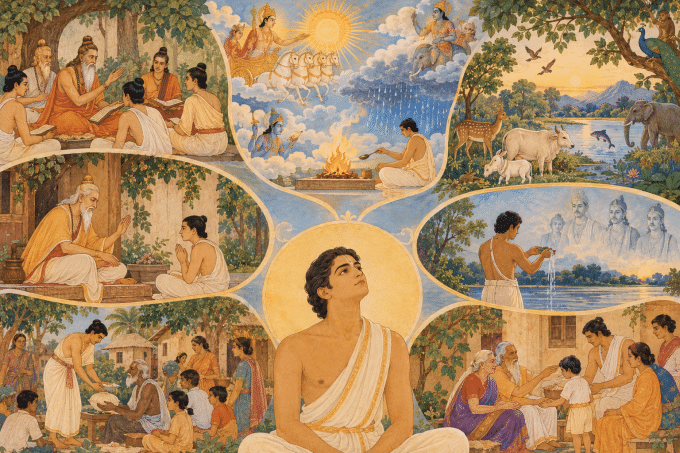
We are born indebted, with loans to the ṛṣis, to the devatās, to the forefathers, to society. Ṛṇa means a loan. The loan to the physical father is paid off by producing a child. The loan to the ṛṣis—we have the knowledge kept here by the predecessors, and by giving it on to posterity we get relief. Guru-ṛṇa, our loan to the guru, we can pay off by making disciples here. “I received it, and I will also give it to others.” I think myself fortunate to have received through the Guru, and it is impending on me that I should help the line continue. Then the bhūta ṛṇa—we get so much from the environment, and by gifts we repay. The deva ṛṇā—the rain, the sunlight, the air and so on; we send some energy to the invisible world by the way of yajña in return. And the relatives, the āpta: from them also we receive, and we help them to a certain extent. A brahmacārī is trained by the help of society, and when he becomes a gṛhastha he clears that loan by doing his duty to society.
But it is said that if one is śaraṇāgata, if he has taken shelter of the Lord, sarva-dharmān parityajya, then these debts one need not clear. If one takes to exclusive hari-bhajana, and if in that process some duty is neglected, one is not responsible. Kṛṣṇa will adjust it on our account.
Still, the devotee does pay. The devotees are very busy paying off what they have drawn before in their past life, the loans of nature. But others are busy accepting new loans from nature and collecting sin within.
How does a devotee pay? tṛṇād api sunīcena taror api sahiṣṇunā. When past actions come to clear their account, I must not refuse. “Oh, I was in debt to you. Take it, take as much as needed." Like a tree, even if he cuts me, I shall not lose my temper. The Lord is there, and He is everything; whatever happens here is transient. I shall meet all complaints as my previous dues, alone and silently, and maintain balance.
Rāmacandra showed the same. When He was told to go to the forest, some said, “Your father has not really pronounced the word. Why should You go?” “No,” He said, “If My father has left some capital, I will take it. But if he has left some loan, then also, as his heir, I must inherit the loan. My father could not speak it out, but he was under obligation, and as his son I must clear that obligation. I must clear my father’s debt, so I must go.”
We must also be careful about what remains. There is a proverb: the remnant of a loan, of a fire and of a war should not be neglected. From the least spark, a great fire can come. From a little animosity of some designing person, a great war may come. The very least portion of a loan can grow into a very big thing. In the same way, the neglected portion of māyā should never be overlooked. A small portion of a disease must not be neglected; if a little is left, a very big disease may come. A wholesale cure is necessary. The possibility becomes less as we make progress, but it is not eliminated fully until the cure is complete.
Then what is the real way? We must enter the land of dedication, and everything will be preserved in the bank. Whatever I dedicate will be kept in a savings bank, to be utilised by me. I shall not draw any cheque; I shall only deposit. The prayer is dāsa kari’ betana more deha prema-dhana, “Make me a servant and give me the wealth of love as wages.” I shall serve, and the remuneration will be more tendency to serve. The interest is converted into capital, and more interest comes, and that is added to capital again, and again more interest. The production comes automatically, to add to the capital. That is the world of dedication. And exploitation is just the opposite—only adding to the loan.
Of course, we are so accustomed to the present civilization that we cannot imagine living big without exploitation. Without a loan, we cannot thrive in this world, an international loan! But to what purpose? Only for food and clothing. Rather, take a loan to acquire a position in the land of the infinite, Vaikuṇṭha. Then not only you, but the loan-giver also will be benefited. We collect funds only with this idea, that we take a loan for the service of the Lord. That is another thing—taking a loan to improve one’s real condition. That is no loan at all. The loan-giver and the loan-taker are both benefited.
In our childhood, in about the thirteenth year, we read in the Hitopadeśa—ekam api akṣaraṁ yas tu guruḥ śiṣye nivedayet. If the guru gives the disciple even one letter, there is nothing in this broad world by which the disciple can clear that debt. Only that one letter can liberate him from the loan. All the resources of the world cannot be compared with it. Such a prospect we have in this world, and it comes from the revealed truth.
The dacoits use acid solution to open an iron chest. In the same way, one drop of nectar in connection with the Absolute can dissolve the long-hardened bondage to the body and mind. And when that bondage is dissolved, he is on the public street, and his business will be to carry the news of the nobility of that solution, from door to door. “A drop of nectar has absolved me from all my loan of exploitation and made me free. You also use this, and you will be free. You will be free of your long-incurred loan from nature, and you will be able to go back to Godhead.” That is hari-kathā—the news of the Absolute, the sweetest of the sweet. It is the only necessity. No other necessity is there.
Vāsudeva Datta prayed to Mahāprabhu, “Release all the suffering souls, and let the burden of their sin be put on my head. I shall go to eternal hell.” And the answer was, “No, no. Kṛṣṇa is not bankrupt, that to release so many souls He will have to make a loan. You are a devotee, and you have put a petition to Him. He will grant it. Rest assured, your life is not necessary for releasing them.”
This is the position. There are general obligations—to the father and mother, to the sages, to the gods, to all. But a man who is exclusively devoted to Kṛṣṇa is not indebted to anyone—na kiṅkaro nāyam ṛṇī ca rājan. One who has given up all these duties and taken refuge under the holy feet of the Lord is not liable to any debt to anyone. Only he who has completely surrendered to the feet of the Supreme Lord is not indebted to anybody. When one has dived deep and sees that Kṛṣṇa is all in all, and that all the others are His servants and agents, then the whole energy can be devoted to the Master. He feels no obligation to anyone, but only to Kṛṣṇa.
And Kṛṣṇa gives His assurance—
sarva-dharmān parityajya mām ekaṁ śaraṇaṁ vraja,
ahaṁ tvāṁ sarva-pāpebhyo mokṣayiṣyāmi mā śucaḥ
He says, “All the debts you have ever incurred, I shall pay off. There will be nothing for you to worry about, to lament. From any position you may come, join Me, and I shall take the full responsibility, because you are My devotee.”