The imitator is like a woman who enters the maternity ward and simply by producing the sounds of labor thinks that she can produce a child. Many things are required before that.
If all of you have been following his teachings for 25-30 years and you are not qualified, then why should I follow his teachings? It must mean that his teachings have no potency. That is what the ritviks are actually saying.
One evening as we sat at Srila Puri Maharaja's lotus feet hearing about what it means to be a genuine Vaisnava, we were astounded when suddenly Srila Puri Maharaja said, "There is a wave of sahajiyaism coming to the Western world and you must preach against this misconception."
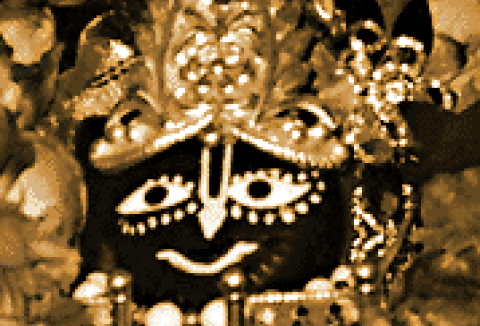
Salagrama-silas are sacred black stones that come from the Gandaki River valley of the Himalayas. Sila means stone. The qualities and characteristics of the Salagrama-silas are not found on stones anywhere on earth except in the Gandaki region.
This ontology on the topic of "Vaishnava" was first compiled in the book Gaudiya Kanthahara, under the chapter Vaishnava-tattva, by Srila Bhaktisiddhanta Saraswati Thakur Prabhupada.
Study, learning, discourse on philosophy so many things are possible prior to initiation (diksha), but unless one gets this ashraya one does not gain admission to the descending flow of bhakti-rasa. To remain in that flow there are requirements also, not that just because I have taken shelter by initiation that I am always connected.
Om is described throughout the Vedic literature and by the acharyas, great spiritual masters, as the seed conception of theism. In the words of Srila Sridhar Maharaja, "Om means 'Yes'. Always, wherever we cast our glance to search, in one word the answer is 'yes'.
Bhaktivinoda Thakura explains in his Sri Chaitanya-Siksamrta that vidhi, regulation that forms the basis of vaidhi-bhakti, is not contrary to raga (spontaneity). Pure vidhi is helpful to raga, and pure raga is a result of vidhi that is in harmony with the will of God. Vidhi helps us cure diseased raga, and when raga is healthy, vidhi retreats.
"So also, to be engaged in (preaching) answering the questions of the environment automatically demands concentration, which is very rare in this age. When one is doing kirtan, he automatically cannot but give all concentration and attention. He cannot speak independently; intuitively, he must be all-attentive. "
A Vaishnava is fearless in all circumstances because he knows that Krishna will always protect him. Yet, if we examine the mood of the great souls, the sadhus and the acharyas, we can detect that a Vaishnava is fearful of only one thing vaishnava-aparadha, not for Himself but for the benefit of His devotees, and He therefore cautions His devotees accordingly.
The sastra and the Bhagavata in particular is full of descriptions of the Supreme Personality of Godhead and His pure devotees. The guru and the sadhu, who are also known as the devotee Bhagavata, lead their lives strictly in accordance with the book Bhagavata.
Thus it can be understood that Kala Krsnadasa was not an eternally liberated soul who fell down from the Lords association but rather he was a candidate from this material world and thus he was still susceptible to maya's influence.