The innate principle of life is to save one's own self, to become immortal, to come out of ignorance, and to become happy. Our very existence is being threatened at every second here where we live; also, ignorance is threatening to cover our knowledge; and we are always being threatened to be swallowed by misery. These are our standing enemies, our born enemies which are constantly threatening us.
The gayatri mantra will excite us to be mindful about Srimati Radharani's lotus feet, to obey her order. Radha-dasyam, the service of Srimati Radharani, is the ultimate meaning to be extracted from the gayatri mantra.
If immortality means 'no influence of mortality' what, then, is its positive conception? What will be the nature, movement, and progress of that which is immortal?
O Divine Master of my Divine Master, my most venerable preceptor, you are supremely worshippable in the group of the foremost associates of Sri Gauranga. May you be gracious upon this servitor surrendered unto your loving servitor (Dayita Dasa). O Gaura Kisora, again and again do I make my obeisance unto you.
This song was composed by Guru Maharaja himself when we moved from the hired house in Calcutta (Bhaktivinoda Asana). The Deities were moved to a constructed matha (Bagh Bazaar Gaudiya Matha). The Deities were carried on a chariot and we were dancing and singing just in front of Them. At that time he composed some six lines perhaps.
Since time immemorial, man has inquired about the origin of the soul. In the thinking of many neophyte devotees the soul falls down from eternal pastimes with Krishna due to mundane envy. In this brief essay, Srila Sridhara Maharaja answers this most vital of all questions: "Who am I? Where have I come from?
The name must be of finite characteristic that can take away all that is undesirable in us. The name must have a spiritual conception not mere physical imitation, that can be produced only by the help of the lip and tongue. Krsna-nama, Hari-nama, Visnu, Narayana, all these are Vaikuntha-nama, it is necessary that They have spiritual existence, that is all in all.
Madhva's propaganda before he met Sri Vyasa was clearly limited to a destructive line of vanquishing mayavada, and it is only after he came under the divine feet of Vyasadeva, the great world teacher of theism, that he took up the constructive side of regular preaching, and made converts and commentaries as an authorized acarya.
They have connection with these nine main types of devotional conceptions respectively. When travelling to these places we are reminded by the incidents connected with them how such representation comes from each place. All of them taken together promote our understanding as to what is devotion proper.
In many places in Srimad-Bhagavatam,we find Lord Brahma, the creator of the universe, being tested by Krsna. And still, Brahma is our gurudeva.He is the original guruof our line. That he could become bewildered is so perplexing and difficult to understand that Madhvacarya eliminated that section from the Srimad-Bhagavatam.He could not accept those two chapters of Srimad-Bhagavatamwhere Brahma was under illusion, where he had some misunderstanding about Krsna. But Sri Chaitanya Mahaprabhu accepted everything in toto.
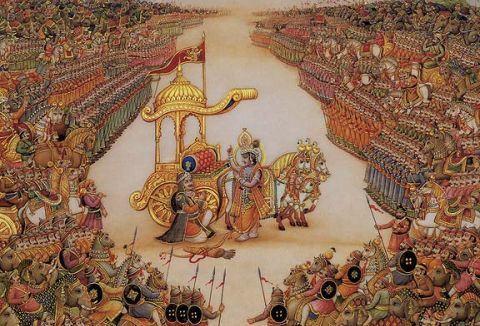
Verses 8-11 are the four principal verses of the Srimad Bhagavad-gita. The ontological substance of the book is contained within these four verses, beginning aham sarvasya prabhavo- "Everything emanates from Me." In the Srimad Bhagavatam, the three main conceptions, of the Absolute are given as Brahman, Paramatma, and Bhagavan.