If all of you have been following his teachings for 25-30 years and you are not qualified, then why should I follow his teachings? It must mean that his teachings have no potency. That is what the ritviks are actually saying.
If immortality means 'no influence of mortality' what, then, is its positive conception? What will be the nature, movement, and progress of that which is immortal?
I stand before you as a teller. I am going to tell you now a few words more on the Vedanta and especially its ontological aspect, morphology being a former changeable part of the same. My telling craves a reciprocity of your listening to my sound through your aural reception. Sound is the main substratum of the Vedanta which deals with a subject unapproachable by our present crippled imperfect senses.
The transcendental wisdom of the ten maxim is being enumerated in ten verses - svatah siddho vedah haridayita-vedyhah prabhrtitah (the Vedic scriptures are the only source of all authoritative wisdom according to words mentioned therein, viz., 'asya maha to bhutasya nisvasitametat'[Rk Veda] etc.
It is due to vaisnava aparadha, losing faith in the conscious agents of the Supreme, that we go to the material substance, "Help me!" I lose faith in the spiritual agency and the long and the short is this - we seek shelter in a material thing and we lose our faith in the higher agency. We can’t see their Grace. So, that is the underlying position of an intoxication monger.
The name must be of finite characteristic that can take away all that is undesirable in us. The name must have a spiritual conception not mere physical imitation, that can be produced only by the help of the lip and tongue. Krsna-nama, Hari-nama, Visnu, Narayana, all these are Vaikuntha-nama, it is necessary that They have spiritual existence, that is all in all.
In the Gaudiya Vaisnava sampradaya, the gayatri which the guru (bona fide spiritual master) gives to the sadhaka (devotee) at the time of diksa (initiation) is that of the Vedic diksa (upanayana) and also that of the Vaisnava pancaratrika-diksa.
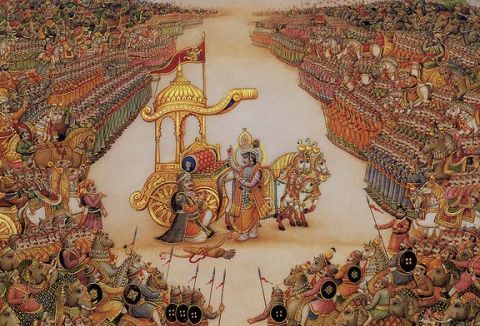
Verses 8-11 are the four principal verses of the Srimad Bhagavad-gita. The ontological substance of the book is contained within these four verses, beginning aham sarvasya prabhavo- "Everything emanates from Me." In the Srimad Bhagavatam, the three main conceptions, of the Absolute are given as Brahman, Paramatma, and Bhagavan.
The absolute infinitesimal has got his free will, and by his free will he can either pose himself as a forgetful agent or he can awaken himself for his original eternal function of remembering his own eternal exploits. The Fountainhead does never wish to delude nor oblige His parts.
This is a reproduction of a conversation with Major Rana N. J. Bahadur at Armadale, Darjeeling on June 14th, 1935. It was originally published in The Harmonist (Vol. XXXI, No.21) on the 27th of June, 1935.