Sripada Narasingha Maharaja once mentioned that everything that Srila Sridhara Deva Gosvami Maharaja spoke was like a sutra. There was so much essential substance in each word.
Some scholars of Gaudiya Vaisnavism claim that the associate of Sri Caitanya Mahaprabhu, Prabodhananda Sarasvati and the Mayavadi sannyasi Prakasananda Sarasvati are one and the same person. From the historical and sastrika perspective it is clear that Prabodhananda was never a Mayavadi sannyasi.
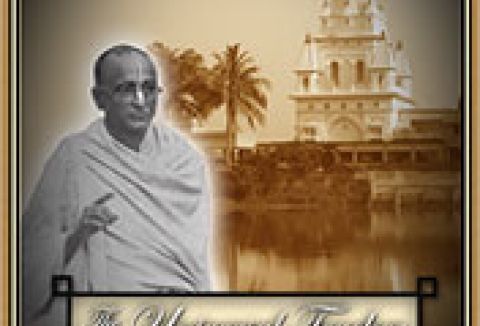
Devavision Productions is pleased to announce the release of the long awaited video THE UNIVERSAL TEACHER [a documentary on the life and teachings of Srila Bhaktisiddhanta Saraswati Thakura].
I have heard it said that there are some gaps in the list of names in the Gaudiya parampara and that some of the names given there are actually fictitious names of personalities that never really existed. Do you think this could be true?
There is a famous temple (Radha Vallabha Mandira) in Vrndavana where the Deities of Radha Vallabha are worshipped and which is visited by many western devotees when they come to Vraja. What is the background of this temple and does it have any link with the Gaudiya sampradaya and it's philosophy?
Sri Guru may be compared to the Pole Star because with the help of the guru we can derive great benefit from the Vedic knowledge. But without the help of the guru we will be bewildered in our attempt to understand the Vedic knowledge.
Srila Bhaktivinode Thakura has written that there were thirteen apa-sampradayas that developed after the time of Sri Caitanya Mahaprabhu. One of these apa-sampradayas is called ativadi, which means too great. Can you please explain how those who are ‘too great’ have become an apa-sampradaya?
There has been some discussion on the use of the honorific title 'Deva' as in the name of Srila B.R. Sridhara Deva Gosvami Maharaja, to the extent that some parties say that it is appropriate, while others say that it is not. Could you please say something that would shed some light on this topic?
We have heard it said that Srila Prabhupada (A.C. Bhaktivedanta Swami Maharaja) received the name "Bhaktivedanta" from his guru, Srila Bhaktisiddhanta Sarasvati Thakura. Others have said that he received the name "Bhaktivedanta" from Srila Sridhara Maharaja and yet others are saying that he received the name "Bhaktivedanta" from Srila Kesava Maharaja. Can you please say something to clarify this issue?
Many devotees are disqualified from understanding finer siddhantic truths by virtue of their impurities, material desires, subtle and gross deviations from the strict line of Sri Rupanuga-varga, and particularly because of their offenses to other Vaisnavas.