
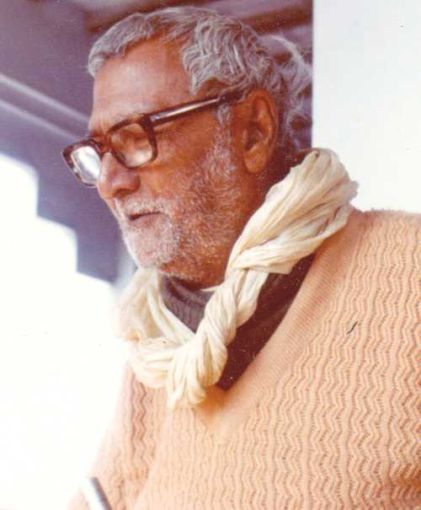
“Srimad-Bhagavatam says that just as in the vast ocean, when nothing else can be seen, the compass is the only guide, so in the world of the infinite, our only guide is the footsteps of those great souls who have traveled on the path of faith. The way has been marked by the holy footsteps of those who have gone to the highest quarter. That is our only hope.” (Srila B.R. Sridhara Maharaja)
Śrīla B. R. Śrīdhara Mahārāja’s statement expresses a central epistemological principle of revealed truth: the Absolute Reality is infinite, while the living being is finite. Therefore, an independent attempt to approach the infinite is inherently unreliable. Just as a sailor lost in the vast ocean cannot depend upon guesswork but must rely upon a compass, similarly, in the immeasurable expanse of the Absolute, our only reliable guidance is the path traced by realized souls.
Śrīmad-Bhāgavatam, The Beautiful Song of God, establishes that truth is not manufactured but received.
Lord Yamarāja declares:
svayambhūr nāradaḥ śambhuḥ
kumāraḥ kapilo manuḥ
prahlādo janako bhīṣmo
balir vaiyāsakir vayam
“These are the twelve mahājanas: Brahmā, Nārada, Śiva, the Four Kumāras, Kapila, Manu, Prahlāda, Janaka, Bhīṣma, Bali Mahārāja, Śukadeva Gosvāmī, and myself.” (Śrīmad-Bhāgavatam 6.3.20–21)
He then gives the conclusive principle:
dharmam tu sākṣād bhagavat-praṇītam
na vai vidur ṛṣayo nāpi devāḥ
mahājano yena gataḥ sa panthāḥ
“Lord Brahmā, Bhagavān Nārada, Lord Śiva, the four Kumāras, Lord Kapila [the son of Devahūti], Svāyambhuva Manu, Prahlāda Mahārāja, Janaka Mahārāja, Grandfather Bhīṣma, Bali Mahārāja, Śukadeva Gosvāmī and I myself know the real religious principle. My dear servants, this transcendental religious principle, which is known as bhāgavata-dharma, or surrender unto the Supreme Lord and love for Him, is uncontaminated by the material modes of nature. It is very confidential and difficult for ordinary human beings to understand, but if by chance one fortunately understands it, he is immediately liberated, and thus he returns home, back to Godhead.”
Thus, the “footsteps” referred to by Śrīla Śrīdhara Mahārāja are the realized path of those great souls. They have already traversed the unknown and reached the goal, and therefore their way alone is safe.
This transmission of truth is living and dynamic, often described through the analogy of one candle lighting another. A single flame, once lit, can ignite countless others without diminishing itself. In the same way, realized knowledge descends from one genuine teacher to another through paramparā, the line of pure lovers of God. Each link carries the same living light. The disciple does not create illumination; he receives it, preserves it, and passes it on. Without that original flame, there is only darkness.
This principle is affirmed in Bhagavad-gītā:
evaṁ paramparā-prāptam
imaṁ rājarṣayo viduḥ
“This supreme science was thus received through the chain of disciplic succession, and the saintly kings understood it in that way…”. BG 4.2
The necessity of accepting guidance is not merely a formal requirement, but a logical and existential necessity. Śrīmad-Bhāgavatam instructs:
tasmād guruṁ prapadyeta
jijñāsuḥ śreya uttamamśābde
pare ca niṣṇātaṁ
brahmaṇy upaśamāśrayam
“Therefore any person who seriously desires real happiness must seek a bona fide spiritual master and take shelter of him by initiation. The qualification of the bona fide guru is that he has realized the conclusions of the scriptures by deliberation and is able to convince others of these conclusions. Such great personalities, who have taken shelter of the Supreme Godhead, leaving aside all material considerations, should be understood to be bona fide spiritual masters.” (Śrīmad-Bhāgavatam 11.3.21)
A true guide, must be both deeply grounded in śāstra and fully realized in truth. He embodies what he teaches.
Śrī Caitanya Mahāprabhu further clarifies:
kibā vipra, kibā nyāsī,
śūdra kene naya yei
kṛṣṇa-tattva-vettā,
sei ‘guru’ haya
“Whether one is a brāhmaṇa, a sannyāsī or a śūdra — regardless of what he is — he can become a spiritual master if he knows the science of Kṛṣṇa.” (Caitanya-caritāmṛta, Madhya 8.128)
Thus, qualification is not external, but based on realization.
The ācāryas strongly caution against the tendency to reject the need for a guru. To deny the necessity of guidance is, in effect, to deny that anyone can know more than oneself, or that one can be helped by another. Such a position is not humility, but the height of conceit. It assumes self-sufficiency before the infinite.
This tendency toward self-sufficiency is not limited to a single tradition, but appears repeatedly across both ancient and modern thought. Certain strands of Zen teaching emphasize direct realization independent of external authority, while figures such as Jiddu Krishnamurti explicitly reject the necessity of guru, declaring that truth must be discovered within and not received from another. In contemporary self-help culture, this same principle is echoed in a more accessible form, where individuals are encouraged to define themselves, determine their own path, and rely upon their own inner resources as the ultimate guide. Though these expressions vary in depth and intention, they converge upon a common assertion: that the individual, by turning inward, is sufficient unto himself. It is precisely this shared assumption that the ācāryas challenge, because it shifts the center of authority from realized truth to the conditioned self.
But there is an inherent contradiction in the claim that no guru or guide is necessary. If one truly requires no guidance, then on what basis should one accept the instruction of the very person making that claim? The moment someone assumes the role of teacher, he implicitly affirms the necessity of guidance. Therefore, to declare “no guru is needed” while instructing others is self-defeating. The claim undermines itself, because it depends upon the very principle it seeks to deny.
In this way, such reasoning collapses under its own weight. The act of teaching establishes hierarchy of understanding, and therefore the need for one who knows and one who learns. To deny that structure while simultaneously operating within it is not a subtle philosophical position—it is a contradiction.
A similar inconsistency appears in statements such as “one who speaks does not know.” If that were truly the case, then the speaker, by voicing that claim, would be admitting his own ignorance. Such a statement invalidates itself the moment it is expressed. If taken seriously, it would require silence, not instruction.
The ācāryas make a clear distinction here. Speech is not rejected, but unauthorized or unfounded speech is. One who is in harmony with the Absolute Truth, who has realized and aligned with it, is qualified to speak. His words carry substance because they are grounded in reality. But one who lacks such realization and yet assumes the role of teacher exposes his own lack of understanding through the very act of speaking.
Therefore, silence is preferable to the speculation of those who preach in a hypocritical way, and realized speech is preferable to both. Those who advocate such contradictory positions would do better to remain silent, because their words lack coherence and substance. Speech should be the expression of truth, not the projection of confusion and contradiction. When one speaks without realization, he does not illuminate the path—he obscures it, and in doing so, reveals his own position. Such foolish teachers should remain silent.
The śāstra, however, leaves no room for such absurdity. Krishna Himself declares:
tad viddhi praṇipātena
paripraśnena sevayā
upadekṣyanti te jñānaṁ
jñāninas tattva-darśinaḥ
“Just try to learn the truth by approaching a spiritual master. Inquire from him submissively and render service unto him. The self-realized souls can impart knowledge unto you because they have seen the truth.” (Bhagavad-gītā 4.34, As It Is, A. C. Bhaktivedanta Swami Prabhupāda)
And further:
nāyam ātmā pravacanena labhyo
na medhayā na bahunā śrutena
yam evaiṣa vṛṇute tena labhyas
“The Supreme Self is not attained by eloquence, intelligence, or much learning. He is attained only by one whom He chooses.” (Kaṭha Upaniṣad 1.2.23)
Realization is descending, not self-generated. It comes through grace, and that grace flows through the channel of the great souls who themselves have recieved the descending current of grace.
Their character is also described:
titikṣavaḥ kāruṇikāḥ
suhṛdaḥ sarva-dehinām
ajāta-śatravaḥ śāntāḥ
sādhavaḥ sādhū-bhūṣaṇāḥ
“The symptoms of a sādhu are that he is tolerant, merciful and friendly to all living entities. He has no enemies, he is peaceful, he abides by the scriptures, and all his characteristics are sublime. (Śrīmad-Bhāgavatam 3.25.21)
Therefore, Śrīla Śrīdhara Mahārāja’s analogy stands complete and unassailable. In the vast and trackless ocean of the infinite, speculation offers no direction. The only reliable compass is the path marked by those self realized souls who have seen The Truth. Their footsteps are the proven way. Their realization is the living light, passed like a flame from one heart to another.
To follow them is wisdom. To reject them is isolation—and in the boundless ocean of the infinite, isolation is not merely darkness, but to drift aimlessly and ultimately drown.