
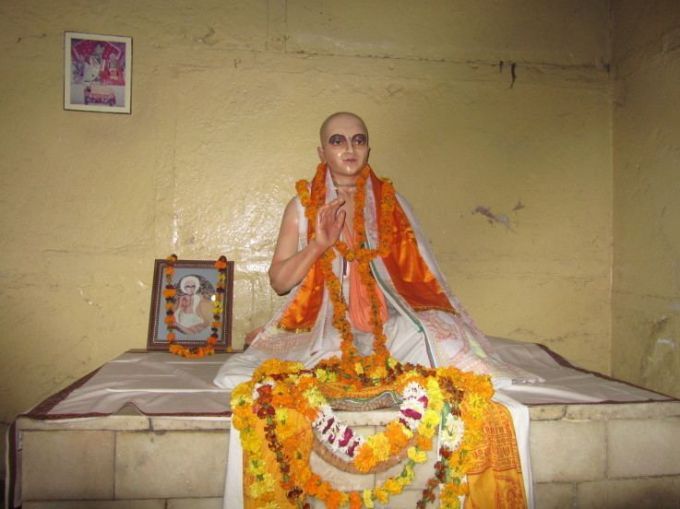
Śrī Jīva Gosvāmī Prabhupāda stands as one of the most brilliant ācāryas of the Gauḍīya Vaiṣṇava tradition. He systematized the teachings of Śrī Caitanya Mahāprabhu in the Ṣaṭ Sandarbhas, guarded the holy places of Vraja, established the Śrī Śrī Rādhā Dāmodara Mandir, and from that very temple trained the leading ācāryas of the next generation. This period marks what can rightly be called the third wave of Gauḍīya history, the first wave being the revelation and līlā of Śrī Caitanya Mahāprabhu, and the second wave being the foundational work of the Six Gosvāmīs who, following Mahāprabhu’s direct instructions, revealed Vṛndāvana, excavated its sacred places, established the principal temples, and composed the bhakti śāstras that define our siddhānta. These Six Gosvāmīs, Śrī Rūpa Gosvāmī, Śrī Sanātana Gosvāmī, Śrī Jīva Gosvāmī Prabhupāda, Śrī Raghunātha Dāsa Gosvāmī, Śrī Raghunātha Bhaṭṭa Gosvāmī, and Śrī Gopāla Bhaṭṭa Gosvāmī, laid the theological and devotional foundation upon which all later Gauḍīya history rests. Under Śrī Jīva’s leadership this second wave matured into an organized effort to protect, teach, and widely distribute the siddhānta of Mahāprabhu.
At Rādhā Dāmodara, Śrī Jīva educated Narottama Dāsa Ṭhākura, Śrīnivāsa Ācārya, and Śyāmānanda Prabhu in Śrīmad Bhāgavatam, in his own Ṣaṭ Sandarbhas, and in the principal works of the Gosvāmīs, with special emphasis on Śrī Rūpa Gosvāmī’s Bhakti–rasāmṛta–sindhu. In that same Vṛndāvana atmosphere, Śrī Kṛṣṇadāsa Kavirāja Gosvāmī completed Śrī Caitanya-caritāmṛta, and these three were nurtured within that living current. They later carried the Gauḍīya granthas, including Śrī Caitanya-caritāmṛta, back to Bengal and Orissa as the theological and devotional canon of Mahāprabhu’s line.
At Śrī Śrī Rādhā Dāmodara Mandir, Śrī Jīva Gosvāmī Prabhupāda convened the first Śrī Viśva Vaiṣṇava Rāja Sabhā. It was not a formal institution as we think of today, but a living council of the foremost Vaiṣṇavas of Vraja, assembled to protect the line of Śrī Caitanya, to clarify and preserve siddhānta, and to nourish the culture of pure devotion in Vṛndāvana. The very name Śrī Viśva Vaiṣṇava Rāja Sabhā expresses its inner purpose, a sovereign assembly of the Lord’s devotees charged with upholding the dignity, purity, and continuity of Vaiṣṇava dharma for all souls. Membership in this sabhā was not a matter of registration, but of realization and character; those whose hearts were illumined by the teachings of Mahāprabhu and the Gosvāmīs naturally stood within its circle. At that time Śrī Jīva was a generation younger than the original leaders of Vṛndāvana, in the strength of his middle years, while Śrī Rūpa and Śrī Sanātana were already elderly and revered as the senior guides of the sampradāya. At its heart stood the Six Gosvāmīs, with Śrī Rūpa Gosvāmī revered as the chief, together with Śrī Sanātana Gosvāmī, Śrī Jīva Gosvāmī Prabhupāda, Śrī Raghunātha Dāsa Gosvāmī, Śrī Raghunātha Bhaṭṭa Gosvāmī, and Śrī Gopāla Bhaṭṭa Gosvāmī. They were joined by exalted associates such as Lokanātha Gosvāmī, Bhūgarbha Gosvāmī, and Kāśīśvara Paṇḍita. Drawing from the celebrated manuscript library Jīva established at the temple, known as Pustak Thaur, the first dedicated library to preserve and store the written works of our Gauḍīya sampradāya, this sabhā functioned as the original council of guardians for Gauḍīya siddhānta and the devotional life of Vṛndāvana.
Below is a biographical sketch from birth to disappearance, followed by a focused look at the unique significance of Rādhā Dāmodara Mandir and the testimony of our later ācāryas about that sacred place.
Śrī Jīva Gosvāmī Prabhupāda appeared at Rāmakeli in Gauḍa, Bengal, as the only son of Śrī Vallabha, later known as Anupama, the youngest of the three famous brothers headed by Śrī Sanātana Gosvāmī and Śrī Rūpa Gosvāmī. Their family belonged to a distinguished Sarasvata brāhmaṇa lineage whose forefathers had migrated from Karnataka to eastern India and later entered government service under the Sultan of Bengal. In recognition of their service the Muslim rulers conferred upon the three brothers the honorific title “Mullik,” a court title that never replaced their original brāhmaṇa identity.
Traditional sources do not present a single agreed chronology for Jīva Gosvāmī Prabhupāda’s life. Some place his lifespan roughly between 1511 and 1596, while others suggest dates such as 1533 to 1618. Modern research, drawing on a handwritten last will preserved in the Vṛndāvana Research Institute, shows that Jīva Gosvāmī Prabhupāda wrote his testament in 1606 and that witnesses signed it at his bedside in December 1608, indicating his departure from this world around that time. In any case, there is broad agreement that he was a saint of the sixteenth century whose life extended into the early years of the seventeenth.
From childhood he showed deep attraction to Kṛṣṇa and quickly mastered Sanskrit grammar and poetics. After the passing of his father, Śrī Vallabha (Anupama), who had begun the journey to Vṛndāvana with his brothers but left this world at Prayāga, Jīva grew up hearing of the extraordinary renunciation of his two uncles, Śrī Rūpa Gosvāmī and Śrī Sanātana Gosvāmī. These elder brothers of his father had abandoned their prestigious ministerial posts under the Sultan of Bengal after receiving the mercy of Śrī Caitanya Mahāprabhu and resolved to dedicate their lives to His service in holy Vṛndāvana. Their sacrifice, their scholarship, and above all their unalloyed dedication to our Lord Gauranga, together with Mahāprabhu’s personal empowerment of them, became the guiding inspiration for Jīva’s own destiny.
Early devotion, education, and journey to Vṛndāvana
When Śrī Nityānanda Prabhu visited Bengal on pilgrimage, the young Jīva met him and was deeply affected. After receiving Nityānanda’s blessings he set out first for Navadvīpa and then for Kāśī (Vārāṇasī).
In Kāśī he studied under Madhusūdana Vācaspati, a disciple of the great Vedāntist Sarvabhauma Bhaṭṭācārya. There he mastered the six classical systems of Indian philosophy, the ṣaḍ–darśanas — Nyāya, Vaiśeṣika, Sāṅkhya, Yoga, Pūrva Mīmāṁsā, and Vedānta. Because of his extensive knowledge, he became the recognized tattva-ācārya, one who understands and can articulate all the tattvas of Gauḍīya siddhānta. This rigorous philosophical training later enabled him to defend Gauḍīya siddhānta at the highest scholarly level.
Around 1535 he finally arrived in Vṛndāvana and placed himself under the care of his uncles Rūpa and Sanātana. He took initiation from Śrī Rūpa Gosvāmī and began assisting in their monumental work of discovering holy places, composing books, and establishing the theological foundations of Mahāprabhu’s movement.
Service under Rūpa and Sanātana
In Vṛndāvana, Śrī Jīva Gosvāmī Prabhupāda became the indispensable assistant and, after their departure, the natural successor of Rūpa and Sanātana. He helped edit their writings, preserved their manuscripts, and defended their conclusions in debate.
After his uncles left this world, Jīva was widely recognized as the foremost authority in the Gauḍīya line. He codified the philosophy of acintya–bhedābheda in his six Sandarbhas, presented Śrīmad Bhāgavatam as “scripture par excellence,” and shifted the perceived center of scriptural authority from the older Vedic corpus to the Bhāgavata Purāṇa.
His works span treatises, commentaries, grammar, and poetry. Among them, the Ṣaṭ Sandarbhas and Gopāla-campū are especially central, while his Hari–nāmāmṛta–vyākaraṇa reconfigures Sanskrit grammar itself around Kṛṣṇa’s names and pastimes.
Establishment of Śrī Śrī Rādhā Dāmodara Mandir
The history preserved at Śrī Śrī Rādhā Dāmodar Mandir tells how Śrīla Rūpa Gosvāmī, following a divine instruction from Śrī Kṛṣṇa in a dream, personally carved the stone Deity of Dāmodara in the year 1542 and offered Him to his dear disciple and nephew, Śrī Jīva Gosvāmī Prabhupāda. Later, two Deities were discovered in a fisherman’s net in Bengal and eventually brought before Śrī Jīva. By divine indication he recognized them as Śrīmatī Rādhārāṇī and Lalitā-sakhī and placed them on either side of Dāmodara on the altar. In this way, the present worship of Śrī Śrī Rādhā Dāmodar in Vṛndāvana unites the Dāmodara Deity carved by Śrī Rūpa with the merciful appearance of Rādhā and Lalitā received and installed by Śrī Jīva.
According to the living tradition of the Śrī Śrī Rādhā Dāmodar Mandir, as preserved by the Gosvāmī family who have been performing uninterrupted sevā there for fifteen generations, the Deities now worshiped in Vṛndāvana are the original Śrī Śrī Rādhā Dāmodar manifested in this way under the care of Rūpa and Jīva. During the reign of the Mughal emperor Aurangzeb, who was known for ordering the destruction of many temples in North India and replacing them with mosques, the Deities of Rādhā Dāmodar were taken to Jaipur for protection. In that dark period the divine forms of Kṛṣṇa in other places were sometimes broken or even buried beneath thresholds and steps so that they would be trodden upon, a calculated insult to bhakti from the Vaiṣṇava point of view. When the danger in Vraja had passed, Śrī Śrī Rādhā Dāmodar were returned to their home in Vṛndāvana, where they have been served continuously since the sixteenth century. A smaller Deity of Dāmodara remained in Jaipur as a pratibhū mūrti, an auxiliary manifestation installed for continued worship. From the standpoint of tattva there is no essential difference between the original Deity and the pratibhū form, both being fully non-different from Śrī Kṛṣṇa and equally worshipable. Still, out of respect for the unbroken sevā–paramparā at Śrī Śrī Rādhā Dāmodar, we stand with the Gosvāmī family’s testimony that they are serving the Dāmodara Deity personally carved by Śrīla Rūpa Gosvāmī.
That same year Śrī Jīva Gosvāmī Prabhupāda formally established the Rādhā Dāmodar Mandir in Vṛndāvana. From then on he made this temple his base of worship, study, and preaching. In Vṛndāvana, Jīva Gosvāmī Prabhupāda established and managed Śrī Rādhā Dāmodar Mandir, and later Gauḍīya Vaiṣṇava accounts also describe him as personally overseeing the worship at the principal temples of Śrī Śrī Rādhā Madana Mohana, Śrī Śrī Rādhā Govinda, and Śrī Śrī Rādhā Gopīnātha, reflecting his position as the leading ācārya of the Vṛndāvana Gauḍīyas.
Within the same temple complex Jīva also established the Viśva Vaiṣṇava Rāja Sabhā, a gathering of Vaiṣṇavas to discuss and promote pure devotion, and the Rūpānuga Vidyāpīṭha, an educational institution for systematic study of the works of Rūpa and Sanātana. He further created a manuscript library known as Pustak Thaur, recognized as Vṛndāvana’s first organized library and the official library of the early Gauḍīya school. Later research and cataloguing work, especially through the Vṛndāvana Research Institute, has shown that many important Bengali and Sanskrit manuscripts, legal documents, land deeds, and texts in handwriting attributed to Rūpa and Jīva were preserved there and later transferred from this original Pustak Thaur into the Institute’s collections. In this way, Rādhā Dāmodar Mandir became simultaneously altar, university, and archive for the growing Gauḍīya community.
Teaching work and disciples
From his base at Rādhā Dāmodar, Śrī Jīva trained some of the most important preachers of the next generation.
Narottama Dāsa Ṭhākura, Śrīnivāsa Ācārya, and Śyāmānanda (Duhkhi Kṛṣṇa Dāsa) all studied under Jīva in Vṛndāvana, mastering Bhāgavata, Bhakti–rasāmṛta–sindhu, Ujjvala–nīlamaṇi and other foundational texts.
After training them, Śrī Jīva Gosvāmī Prabhupāda entrusted these three with the original manuscripts of Rūpa and Sanātana and instructed them in 1558 to return to Bengal and Orissa to distribute bhakti and those writings to the broader Vaiṣṇava community.
In this way, Narottama Dāsa Ṭhākura, Śrīnivāsa Ācārya, and Śyāmānanda Prabhu emerged as the first great distributors of the Gosvāmīs’ books, carrying the heart of Vṛndāvana in the form of those manuscripts to Bengal, Orissa, and beyond. Therefore, it can be said these three great acharyas were the first book distributors.
Thus the Rādhā Dāmodar Mandir functioned as a kind of theological launching pad; the books composed and preserved there were carried out to the rest of the Gauḍīya world by Jīva’s direct students.
Life at Rādhā Dāmodar: worship, writing, and association
Within the temple complex one finds today the now covered courtyard with the samādhi and bhajan-kuṭīra of Śrī Rūpa Gosvāmī, together with the samādhis of Śrī Jīva Gosvāmī Prabhupāda, Kṛṣṇadāsa Kavirāja Gosvāmī, and Bhūgarbha Gosvāmī. Elsewhere in the temple is the sacred Govardhana–śilā given by Kṛṣṇa to Śrī Sanātana Gosvāmī. One also finds the puṣpa–samādhis of more recent notable ācāryas such as Śrīla Bhaktisiddhānta Sarasvatī Ṭhākura and Jagad Guru Swami Bhakti Gaurava Narasiṅgha Mahārāja, as well as the bhajan-kuṭīras of Śrīla A. C. Bhaktivedānta Swami Prabhupāda and, directly above it, the bhajan-kuṭīra of his disciple, Jagad Guru Swami Bhakti Gaurava Narasiṅgha Mahārāja.
During Jīva’s lifetime the temple functioned as a living center of association among the leading Vaiṣṇavas of the age. Śrī Rūpa Gosvāmī resided there and performed his bhajana, and his samādhi remains the heart of the courtyard. Kṛṣṇadāsa Kavirāja Gosvāmī, the author of Caitanya-caritāmṛta, worshiped his Deities Rādhā Vṛndāvana-candra there, situated to the right of Rādhā Dāmodar. The Deities Rādhā Mādhava of Śrī Jayadeva Gosvāmī and Rādhā Cailacikānātha of Bhūgarbha Gosvāmī are also worshiped on the main altar.
Jīva’s own daily life at Rādhā Dāmodar combined intense Deity worship, philosophical writing, teaching, and the practical management of temple properties and patronage, as reflected in the land documents preserved in his library. During this period he also commanded respect beyond the Vaiṣṇava community, and the Mughal emperor Akbar is said to have become his admirer and to have donated paper for his writings, a valuable gift in those days.
Disappearance and samādhi
Śrī Jīva Gosvāmī Prabhupāda passed away in Vṛndāvana, with most traditional accounts placing his disappearance near the beginning of the seventeenth century. His samādhi lies inside the Rādhā Dāmodar compound itself.
From that time onward the temple became not only his place of worship but also his eternal resting place, guarded through generations by the sevaites descended from Kṛṣṇa Dāsa Gosvāmī, whom Jīva himself appointed as the first temple manager.
The continuing significance of Rādhā Dāmodara Mandir
Within the Rādhā Dāmodara temple complex stand the samādhis of Śrī Jīva Gosvāmī Prabhupāda, Kṛṣṇadāsa Kavirāja Gosvāmī, and Bhūgarbha Gosvāmī, along with the puṣpa–samādhi of Śrīla Bhaktisiddhānta Sarasvatī Ṭhākura, where his disappearance day is regularly observed. The temple thus becomes a visible point of connection between the original Six Gosvāmīs and the later reformers of the Brahma–Madhva–Gauḍīya line.
Prabhupāda’s bhajana–sthali and his statements
In modern times the significance of Rādhā Dāmodara Mandir was further highlighted by the residential bhajana-kuṭīra of Śrīla A. C. Bhaktivedānta Swāmī Prabhupāda. For six years, from 1959 until he left for the West in 1965, Prabhupāda lived in two small rooms in the courtyard, beginning his multivolume translation of Śrīmad Bhāgavatam and writing works such as Easy Journey to Other Planets. During this period he also composed a substantial manuscript on the meeting of Śrī Caitanya Mahāprabhu and Śrī Rāmānanda Rāya, later published from a rediscovered handwritten copy as In Search of the Ultimate Goal of Life. He was constantly writing in those rooms, filling loose sheets and notebooks, but much of that early work has since been lost, and no complete inventory of his manuscripts from Rādhā Dāmodar now exists.
In a 1967 letter he wrote:
“Śrīla Jīva Gosvāmī’s temple is my heart and soul.”
Referring to his own rooms there, he also said:
“This corner at the Radha Damodara temple is just like the hub of the wheel of the spiritual world, it is the center.”
In the Bengali Gītā–gān, in his personal maṅgalācaraṇa, Prabhupāda further glorified the temple:
“Vṛndāvana is a charming place, and situated there in the grove known as Seva–kuñja is the sacred temple of Śrī Śrī Rādhā Dāmodara.”
Taken together, these statements show that he saw the mandir not merely as a historic site but as a living center of spiritual energy, intimately connected with his mission.
Testimony of other ācāryas
Śrīla B. G. Narasiṅgha Mahārāja, reflecting on Prabhupāda’s words and on the presence of Radha Damodara and so many Gosvāmīs’ samādhis, once said:
“There can be no better place on earth to render service than at the Radha Damodara Mandira.”
He notes that at Rādhā Dāmodara, in the presence of the samādhis of Rūpa Gosvāmī, Jīva Gosvāmī Prabhupāda, Bhūgarbha Gosvāmī, and Kṛṣṇadāsa Kavirāja Gosvāmī, Prabhupāda became “fully empowered” for his world mission while residing and praying there. In another reflection on Prabhupāda’s mood at the temple, Narasiṅgha Mahārāja explains that in “Śrī Śrī Rādhā Dāmodara Mandir and Śrī Rūpa Samādhi,” Prabhupāda performed his bhajana “in the loving devotional mood of the residents of Vṛndāvana.” Thus Rādhā Dāmodara stands not only for philosophy and book distribution, but also for the inner current of rāgānugā–bhakti.
Summary: Jīva Gosvāmī and his temple
In modern times the significance of Rādhā Dāmodara Mandir was further highlighted by the residential bhajana–kuṭīra of Śrīla A. C. Bhaktivedānta Swāmī Prabhupāda. For six years, from 1959 until he left for the West in 1965, Prabhupāda lived in two small rooms in the courtyard, where he began his multivolume translation of Śrīmad Bhāgavatam and wrote works such as Easy Journey to Other Planets. During this period he also composed a substantial manuscript on the meeting of Śrī Caitanya Mahāprabhu and Śrī Rāmānanda Rāya, later published from a rediscovered handwritten copy as In Search of the Ultimate Goal of Life. He was constantly writing in those rooms, filling loose sheets and notebooks, but much of that early work has since been lost, and no complete inventory of his manuscripts from Rādhā Dāmodar now exists.
For a Gauḍīya Vaiṣṇava, then, to study the life of Śrī Jīva Gosvāmī Prabhupāda is to be drawn naturally toward the temple and courtyard of Śrī Rādhā Dāmodara Mandir. His biography and his temple are one story: the story of how pure devotion, precise siddhānta, and sacred geography converge in a single place that continues to radiate influence through the entire disciplic succession.
For those who stand in the Gauḍīya line today, Rādhā Dāmodara Mandir is not only a place on the map but a living synthesis of our paramparā. Within this sacred temple complex we meet Śrī Jīva Gosvāmī Prabhupāda, the guardian of siddhānta; Śrī Rūpa Gosvāmī, the crest jewel of rāgānugā–bhakti; Śrī Kṛṣṇadāsa Kavirāja Gosvāmī, the historian of Mahāprabhu’s līlā; Śrīla Bhaktisiddhānta Sarasvatī Ṭhākura, the lion-guru of the modern age; and Śrīla A. C. Bhaktivedānta Swāmī Prabhupāda with his devoted disciples, like our own Jagad Guru Swami Bhakti Gaurava Narasiṅgha Mahārāja, who helped carry their current to every continent. To approach that temple with faith is to stand in the stream of their hearts’ work and to remember that our own service, however small, is meant to flow into that same ocean of devotion to Śrī Śrī Rādhā–Dāmodara.