
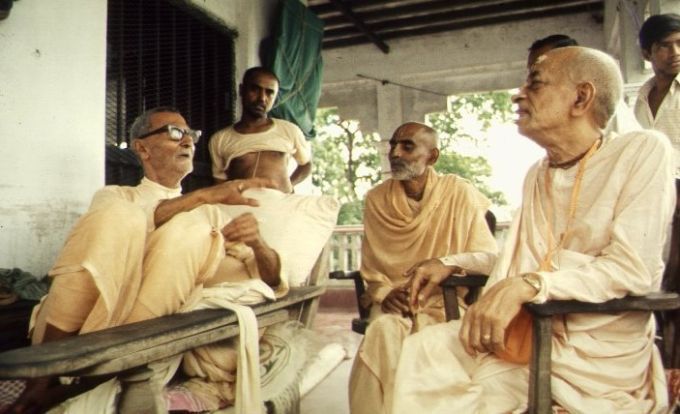
“To err is inevitable for all, being not perfect. Still, no one wants to remain imperfect. There is an element within all that is animate that tends towards perfection… Our limited capacity and tendency for perfection makes room for the guide or Guru… So the guidance to perfection or Absolute Truth is necessarily a function of the Absolute Himself, and the divine agent through whom this function manifests is Śrī Guru¹ or the divine guide.” (Śrīla Bhakti Rakṣaka Śrīdharadeva Goswami Mahārāja, Śrī Guru and His Grace)
At the same time, the ācāryas² teach us to hold a sober, multi-layered understanding: the absolute side of Śrī Guru, the relative side of Śrī Guru, and the practical (worldly dealings) side of Śrī Guru. When these are not harmonized properly, devotion becomes either sentimental fanaticism or fault-finding offense.
Śrīla Bhakti Rakṣaka Śrīdharadeva Goswami Mahārāja teaches that the pāramārthika³ vision (absolute faith) and the vyāvahārika⁴ plane (relative, practical dealings) must be adjusted without disturbing the disciple’s faith:
“In this way we can adjust everything… Both the absolute faith and the relative position of the non-absolute, these two things should be harmonised.” (Sri Guru and His Grace)
This is not theoretical. This is practical life in a living mission. The disciple’s connection to guru may not be the same as the godbrother’s connection to guru, the parent’s connection to the son, or the government’s connection to a citizen. Śrīla Śrīdhara Mahārāja states plainly:
“The position of Āchārya is a relative thing, and the position of the disciple is also relative, just like the relationship between mother and child, father and son, wife and husband. Although to his godbrothers a Guru will be seen in a relative position to his disciple, the Guru is absolute.” (Sri Guru and His Grace)
So the disciple may see his Guru as “all-in-all,” and that is the disciple’s rightful domain of surrender.
“Our system is autocratic. Guru is all-in-all. Our submission to Guru is unconditional.” (Sri Guru and His Grace)
Yet the same person may be seen differently by different observers due to relationship, jurisdiction, and rasa⁵, without contradiction and without offense.
Śrīla Śrīdhara Mahārāja gives a striking example to establish this principle:
“Just as when Kṛṣṇa entered into the arena of Kaṁsa he appeared differently to different persons, the disciples will have one view of their Guru, and his godbrothers will have another view and disposition.” (Sri Guru and His Grace)
He continues:
“In madhura-rasa⁶, Kṛṣṇa is seen in one way, and in vātsalya-rasa⁷, Mother Yaśodā sees Him in another way. The servants see Him in another way. The ṛṣis⁸ like Garga Muni will see Him in another way. As Kṛṣṇa likes to show Himself, He will be seen.” (Sri Guru and His Grace)
This is the relative side of Śrī Guru. The disciple has one vision. A godbrother, by his particular relationship and privilege of familiarity, may have another disposition. Parents will naturally see their son as their child. The state will see the guru as a citizen under law. None of this cancels the disciple’s absolute faith, unless the disciple commits the error of demanding that everyone must see what he sees.
And here we must add a point that directly touches the disciple’s inner world. If devotees are present before a Vaiṣṇava⁹ they accept as guru if, in that atmosphere, they have the vision that this Vaiṣṇava is capable of assuming the role of ācārya, then it is improper for someone to begin proposing another godbrother or another senior devotee as “more qualified” to lead. Even if such opinions exist privately on the relative plane, to assert them in that setting is to intrude upon the disciple’s pāramārthika vision and to agitate śraddhā¹⁰. When this is done, an offense is committed, not only toward the guru in question, but also toward those followers whose faith is naturally resting at his feet.
Śrīla Śrīdhara Mahārāja therefore stresses careful behavior from the relative side so the absolute faith of others is not disturbed:
“You may see the Guru in your own way, but still, you’ll have to behave in such a way that the newcomer’s faith will not be disturbed.” (Sri Guru and His Grace)
He further says:
“On the other hand, I may have my own conception about my godbrother. I may foster that within my heart. As much as possible I should try not to disturb his disciples.” (Sri Guru and His Grace)
And he also explains how the mission is protected through proper public etiquette, even when private familiarity exists:
“Even if you think that the person performing the function of āchārya is lower in qualification, adhikār¹¹, than you, still you should formally give some special honour to him because he is in that position.” (Sri Guru and His Grace)
Fanaticism begins when one takes the disciple’s internal pāramārthika realization and tries to impose it as a universal social law, what Gaudiya Vaishnavas often express as “amar guru jagad-guru”¹² (“my guru is the jagad-guru,” the guru of the whole world and should be recognized by all; those who don’t are offenders). The fanatic feels that because I see my guru as all-in-all, everyone must see him in the same way, and if they do not, they are offenders. That mood is poison, because it confuses the disciple’s private plane of surrender with a public demand placed upon all observers.
Once, while doing kitchen service for Śrī Guru, he asked us to come up with some new soup. I made carrot soup and offered it. After seeing the carrot soup and not being satisfied with it, he declared, “No one makes carrot soup!” In my mind I thought, “But I did.” Of course, there are probably a thousand recipes for carrot soup, so from the relative plane it is a false statement, if taken literally. A fanatic would force the words into a rigid, factual mold, as if every utterance must function like a literal, external report. But the disciple must come to the platform of understanding his Guru’s inner intention (āśaya)¹³, which may not always be expressed in a way that satisfies literalism. Otherwise, cognitive dissonance will manifest in the mind of the disciple: either he will twist reality to protect a crude interpretation, or he will lose faith because he expected his guru to speak like an infallible dictionary.
Another example is that A. C. Bhaktivedanta Swami Maharaja Prabhupāda gave different instructions on the order of offering paraphernalia to the deity at his different temples. Then one day two pūjārīs¹⁵ from different temples were engaged in offering ārati¹⁴. When each saw the order of the things offered were offered in a different sequence they both began to fight what order was correct. But “Śrīla Prabhupāda said, Śrīla Prabhupāda said.” Not understanding that both ways were correct because they were both taught different orders, it caused them to argue and fight. This is how a narrow literalism, mixed with institutional identification, can turn service into quarrel, because the devotee clings to an external form as the only proof of fidelity, rather than honoring the intention behind the instruction and the legitimate variation of practice according to time, place, and circumstance.
Śrīla Śrīdhara Mahārāja teaches taṭastha-vichār¹⁶, an impartial weighing of considerations, precisely to avoid this confusion:
“This is called taṭastha-vichār: an impartial comparison of relative and absolute considerations. When the two are weighed, the absolute calculation will always have the greater value.” (Sri Guru and His Grace)
In other words, the absolute plane has greater value, but the relative plane still exists and must be recognized as a fact of life. If we deny the relative plane, we become fanatics. If we deny the absolute plane, we become offenders.
Now we come to the practical side, the human traits, habits, temperament, and ordinary dealings that may not always look “inspired” to a casual observer. Śrīla Śrīdhara Mahārāja cautions the disciple not to reduce guru to externals, or to expect him to appear as an unchanging public image:
“But at the same time, as we offer reverence to Gurudev, we must not conceive that the Guru is a doll, a lifeless figure.” (Sri Guru and His Grace)
And he defines where the disciple should place his real attention:
“The important thing is what he says, his instructions.” (Sri Guru and His Grace)
The disciple is not meant to worship a body or a social role, but to trace the living current of divinity expressed through instruction and service connection.
Finally, Gauḍīya siddhānta¹⁷ is uncompromising that the Absolute must remain supreme when there is a clash:
“There is the absolute consideration and the relative consideration. When they come into clash the relative must be given up, and the absolute should be accepted.” (Sri Guru and His Grace)
So the conclusion is not confusion, but harmony: the disciple maintains the absolute vision of Śrī Guru in his surrendered heart; the godbrother maintains proper etiquette and does not injure śraddhā; parents and society naturally relate through their jurisdiction; and the serious seeker knows that when absolute and relative conflict, the absolute must prevail. This is how we preserve both devotion and sanity, faith without fanaticism, and discrimination without offense.
Jagad Guru Swāmī B. G. Narasiṅgha Mahārāja, once said, “I have read this book Śrī Guru and His Grace at least one hundred times.” In the present spiritual landscape, where many ācāryas are manifesting, His Divine Grace Śrīla Bhakti Rakṣaka Śrīdhara Deva Goswāmī Mahārāja has left us a treasurehouse of mercy in the form of this book, which has been of immeasurable help to many who are treading the path of bhakti-yoga in these times.
Footnotes
[1] Śrī Guru: the divine guide; the Lord’s delegated representative who connects the jīva to the Absolute through instruction and service.
[2] Ācārya / ācāryas: spiritual teacher(s) who instruct by example and transmit the line’s teaching.
[3] Pāramārthika: pertaining to ultimate (absolute) truth; the disciple’s inner plane of absolute faith.
[4] Vyāvahārika: pertaining to practical, relative dealings; the plane of ordinary transactions and social/worldly considerations.
[5] Rasa: devotional “relationship-taste” or mood of loving exchange with Kṛṣṇa.
[6] Madhura-rasa: the conjugal mood.
[7] Vātsalya-rasa: the parental mood.
[8] Ṛṣis: sages/seers.
[9] Vaiṣṇava: a devotee of Viṣṇu/Kṛṣṇa.
[10] Śraddhā: faith; the inner trust that sustains bhakti and receptivity to divine guidance.
[11] Adhikār: qualification, capacity, eligibility (spiritual “standing” for a function/role).
[12] “Amar guru jagad-guru”: Bengali phrase meaning “my guru is the guru of the whole world”; used here to describe a fanatic social imposition of one’s private vision.
[13] Āśaya: inner intention; underlying purpose behind one’s expression.
[14] Ārati (ārotik): the ceremonial offering of light (and other items) to the Deity.
[15] Pūjārī: priest/servant engaged in Deity worship.
[16] Taṭastha-vichār: impartial consideration; neutral weighing of relative and absolute factors.
[17] Siddhānta: settled theological conclusion; the tradition’s established doctrinal truth.