
(From various talks of Śrīla B.G. Narasiṅgha Mahārāja)
Introduction — Purity, Not Pleasantness
There is a great deal of kīrtana being performed in the world today. If you go on YouTube or even Facebook, you will see so many people chanting Hare Kṛṣṇa. You will find professional singers also chanting hari-nāma, and to the ear it may sound very melodious, very nice. But we should understand that the standard of kīrtana is not simply whether the sound is pleasing to the ear. We are not looking for the nice sound. We are looking for the purity of the sound.
A sound may be beautiful, but the conception of the person making that sound also enters the ear and the heart. If the conception is impure, then the sweetness of the sound does not make it beneficial. And the opposite is also true: something may not be particularly pleasing to our senses, but if it is chanted purely, the purity is there, and that enters the ear and the heart.
Śrīla Sarasvatī Ṭhākura gave a very practical example of this. Śrīla Śrīdhara Mahārāja was not known for having a beautiful singing voice, especially in comparison with some of his godbrothers. Yet Sarasvatī Ṭhākura asked Śrīdhara Mahārāja to sing at a disappearance-day observance. Śrīdhara Mahārāja was reluctant, but eventually he sang, and Sarasvatī Ṭhākura was very satisfied. He was not looking for the tune. He was looking for the purity within the sound.
The question is not whether we enjoy the kīrtana, but whether we are serving the Holy Name. There is a subtle spirit of serving that has to be cultivated. When a mother serves dinner to her family, it is not merely a job. There is affection and love in the service. We have to have that same attitude when we sing the Name—serving the Name of Kṛṣṇa. It is a finer feeling, and we cultivate it. Those who enjoy singing Hare Kṛṣṇa are called sahajiyās, whereas those who perform kīrtana as service to the Holy Name of Kṛṣṇa are devotees.
Kīrtana not a Performance
Kīrtana should never become a performance. There are many singers who make tapes of Hare Kṛṣṇa mahāmantra, bhajans, Prabhupāda-namaskāra and Pañca-tattva-mantra. The music may be very nice, they may give some satisfaction to the senses, but that alone does not purify the heart. The sound must carry the proper conception, by persons following the rules and regulations—not simply with a good voice and cinema-style music.
Discrimination is needed when we hear recorded bhajans. You can take all the bhajan tapes available today and lay them out, and very few will actually nurture the devotion of a devotee who is a little elevated on the path of bhajan. There is a big difference between sangeet and bhajan. There may be very good singers. Sometimes the sweetest kīrtanas that appear on tapes and DVDs are not spiritual at all. They may be sung for public glorification, attention or money. They are not sung from the heart of love and purity. They are mostly filled with ego.
I don't even listen to a kīrtana tape that we produce, because the background is just a chorus. It's nice, it's harmonious, but that's just a little touch of enjoyment. I go for the rougher kīrtan, not the one that's made melodious so that the public is sure to like it. That is not a bad kīrtan, per se, but when I'm sitting in my own room, I prefer to hear Śrīla Prabhupāda chanting. It is better to have even one drop of pure nectar than an ocean of sweet rice with sand inside.
I once asked Rūpānuga for a report on the kīrtana at a particular temple in Vṛndāvana he had visited, and what I heard was bizarre—people gyrating, break dancing, guys turning it on, all the girls standing around. I said, "This is not kīrtan. This is not the Holy Name." It was all show-bottle: "Look at me. Look how hot I am on the mṛdaṅga. Look how big my kartāls are." That is an external show.
‘Nevermind Ecstatic’
When dancing became a little out of control in the 1970s, Śrīla Prabhupāda nipped it. Prabhupāda said, "Tell them, dance like I taught them in 1965." That was what devotees called the Prabhupāda two-step—one step to the left and one to the right. That became the standard for the festival. When the devotees returned to their stations, some felt that things were no longer as fired up as before. One devotee wrote to Prabhupāda that since they had stopped the ecstatic dancing, the kīrtanas were not as ecstatic. Prabhupāda wrote back, "Nevermind ecstatic."
What do you mean, ecstatic? Ecstasy was being used as a cheap word. He understood that what people were calling ecstasy could simply be youthful bile secretion. Unfortunately, many antics have also entered kīrtana with all kinds of strange behavior. None of that is kīrtana.
The Proper Instruments of Kīrtana
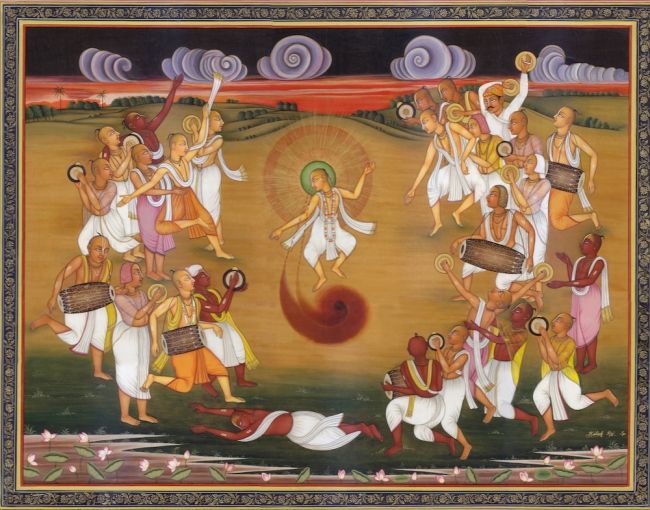
Once we understand that kīrtana is service, we can also understand why the form of the kīrtana matters. Saṅkīrtana was begun by Śrī Caitanya Mahāprabhu, and the instruments of that saṅkīrtana were the khol and kartālas. These instruments set the rhythm and pace; they do not compete with the voice. In music you may have a lead guitar or harmonium, but in kīrtana and bhajan you do not have lead instruments in that sense. The lead instrument is the voice. The voice sets the tone and can communicate knowledge. A guitar cannot communicate knowledge in that way.
Therefore we should not be trying to improvise with instruments or take the lead away from the voice. The voice is the supreme instrument. The other instruments have a limited function: they support the chanting.
In the early days of Śrīla Bhaktisiddhānta's mission, Śrīla Purī Mahārāja said that at night they would sometimes hear the kīrtana coming from Śrīvāsaṅgana—the eternal kīrtana. And in that kīrtana there was simply kartāla and mṛdaṅga. That was enough. In Śrīla Purī Mahārāja's āśrama there was no harmonium. It was kartāla and mṛdaṅga.
In Bengal the khol is part of the tradition; the tabla is a Persian instrument. The harmonium is not from India, and the guitar is also not from India. Śrīla Prabhupāda himself played harmonium at home, but he did not like it in the morning program. Harmonium was not allowed in maṅgala-ārati and similar services.
Śrīla Bhaktisiddhānta Sarasvatī did not allow harmonium in his temples. Why? Because the sahajiyās had captured that instrument. They used the sweet sound and then went into crying. In the āśramas of Śrīdhara Mahārāja, playing the harmonium was treated much like playing the saxophone. It was not part of their saṅkīrtana standard. For the saṅkīrtana movement that Śrīla Prabhupāda introduced, the instruments were essentially kartāla and mṛdaṅga.
The Mahāmantra is Central
The Mahāmantra has to remain at the center of our kīrtana. In the beginning of the saṅkīrtana movement in the West, devotees were enthusiastic and wanted to shout different things. They asked Prabhupāda if there was anything they could shout, and his answer was "Haribol." But even that was to be limited to a very small part of the kīrtana—less than five percent, I would say. The greatest benefit for the chanter, the hearer, and even the trees is the Mahāmantra.
There are also forms of kīrtana which are not meant for everyone. Sometimes people chant "Rādhe Kṛṣṇa, Rādhe Śyām" and pick it up as though it were ordinary sādhana kīrtana. But that is not for the public and not for beginner devotees. It is sometimes chanted by realized persons such as Kṛṣṇa Dāsa Bābājī. That is realized kīrtana, not ordinary sādhana kīrtana. You will not hear Śrīla Prabhupāda singing it, nor will you hear Śrīla Śrīdhara Mahārāja singing it – in order to set an example.
Kīrtana and Japa
Kīrtana is not really a meditation in the quiet sense. It is like taking a bath in a waterfall. Most people do not fall asleep in kīrtana, but practically everybody falls asleep doing japa at some point. Kīrtana is very aggressive in its attack. It is in the fighting mode—it is attacking Māyā. Japa is not attacking Māyā in the same way. But there is a time and a place for kīrtana. You cannot always do kīrtana. That is a fact. Your beads can go everywhere and anywhere, but kīrtana cannot always be performed. Sometimes kīrtans are prohibited by authorities; Sometimes a situation is just not right for a kīrtan; Sometimes devotees cannot sing or carry a tune, in which case kīrtana can be difficult to perform. However, it is certainly an important part of the process.
Qualifications for Nāma-saṅkīrtana
We should not imagine that Mahāprabhu's saṅkīrtana was simply a democratic gathering where anyone could enter into any kīrtana at any level. There were qualifications. Mahāprabhu's Rāsa-kīrtana was not public. Not everybody could enter.
There was one man who wanted to enter the kīrtana at Śrīvāsaṅgana, but they kept him outside. He tried to establish his qualification by saying that he was very pure because he lived only by drinking milk. But what kind of qualification is that? Almost all babies live on milk, and a few old men may do so. Is that the qualification for entering a higher plane? He became frustrated and cursed Mahāprabhu.
And when Mahāprabhu came to Śrīvāsa's house, even the members of Śrīvāsa's own household were not necessarily allowed into the kīrtana taking place in the courtyard. So there are no self-invites to the highest service. We have to understand that higher service carries higher qualifications.
The same principle applies to saṅkīrtana generally. There is qualification for Nāma-saṅkīrtana. There is qualification for sādhu-saṅga. There is qualification for worshiping the Deity. In one example, people who were not qualified would be kept simply hearing the Holy Name properly for six months before being considered for participation. If they again showed sahajiya tendencies, they would be disallowed again.
Kīrtana under the Guidance of a Pure Devotee
Bhaktivinoda says that the kīrtana must be led by a pure devotee. But how can that always be possible? Even when a pure devotee is not physically present, the kīrtana must remain under his guidance. The pure devotee may be in another room, another country, another part of the planet, or may have already left the planet. Nevertheless, the devotees in the kīrtana must remain under the guidance of that pure devotee and that line. It is up to the line to guard the kīrtana against the enjoying spirit.
Kīrtana Is Not Proven by Emotion
Tears are not proof of bhāva. I heard one kīrtana where two hundred devotees were crying and the leader was said to be so ecstatic. I thought, "Two hundred people were crying—what was it, tear gas in the room?" Two hundred people do not experience bhāva together simply because one person is displaying emotion. There may be sentiment, but bhāva is not such a cheap commodity. It does not simply come down and fill a room with two hundred people.
There has to be discrimination. I remember a case where a recording of a devotee's dramatic kīrtana was taken to Śrīla Śrīdhara Mahārāja. He was not told the background. They put on the tape and he listened for only a few seconds before knocking off the headphones and saying, "Māyā's kingdom. Māyā sound." That was his discrimination. Later it came out that the person involved had been taking LSD and then sitting before devotees chanting and becoming the big shot. He had become degraded, but people had judged everything from the externals.
The History of Saṅkīrtana and the Loss of the Standard
The importance of this discrimination becomes clearer when we look at the history of saṅkīrtana. After the disappearance of Mahāprabhu, saṅkīrtana continued, but the weight of the tradition gradually shifted toward internal bhajan. Eventually saṅkīrtana waned to the point that many groups considered chanting Hare Kṛṣṇa in saṅkīrtana to be bogus. By the time of Bhaktisiddhānta Sarasvatī, saṅkīrtana parties were often not chanting the Mahāmantra at all. They chanted the Mahāmantra in japa, while their public singing consisted of līlā-kīrtanas.
Śrīla Bhaktisiddhānta's preaching was forceful, and he demonstrated from śāstra that the Mahāmantra belongs in saṅkīrtana. If you do not chant the Mahāmantra in saṅkīrtana, then you are not following the standard of Mahāprabhu. This was the battle of his day. The Mahāmantra in saṅkīrtana was essential to the claim of belonging to the paramparā.
At the same time, there was a danger on both sides. Authentic saṅkīrtana had waned, but authentic internal cultivation had also waned. The Sahajiyās then got a grip on the subtle plane. They were not qualified for genuine internal bhajan, so false sentiments, crying and external exhibitions took its place.
Once the standard of service and qualification is lost, people begin looking for something that feels spiritual. They seek sweetness, tears, secret teachings, dramatic experiences, special personalities and external signs. Eventually the whole thing can become very perverse.
When the Real Holy Name Descends
When the real Holy Name descends, something altogether different happens. In the beginning you chant Hare Kṛṣṇa, but in the end Hare Kṛṣṇa dances on your tongue. You are not even the chanter anymore. When the real Name of Kṛṣṇa descends, He takes over completely. He orchestrates the kīrtana. You do not. At that point you are almost a bystander.
That is the real movement toward the Holy Name. In the beginning we move toward the Name and we are behind the chanting. But when the chanting is pure, the chanting itself takes over. It is another sound, not recognizable to any ordinary set of ears.
The goal is kīrtanīyaḥ sadā hariḥ. We want to come to the point where we are no longer trying to make the kīrtana happen according to our own conception. We are trying to become fit to serve the Holy Name. In the beginning we chant the Name. In the end, the Name dances on our tongue.
That is the kīrtana we are looking for—not the nice sound, but the pure sound; not performance, but service; not manufactured ecstasy, but genuine devotion; not our own invention, but the living current of the paramparā.
That is the standard.